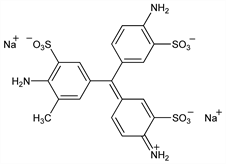
107. Acid Fuchsin
Nomenclature
CAS number: 3244-88-0
2-Amino-5-[(4-amino-3-sulfophenyl)(4-imino-3-sulfo-2,5-cyclohexadien-1-ylidene)methyl]-3-methylbenzenesulfonic
acid sodium salt (1:2); C.I. Acid Violet 19; 2-amino-α5-(4-amino-3-sulfophenyl)-α5-(4-imino-3-sulfo-2,5-cyclohexadien-1-ylidene)-3,5-xylenesulfonic
acid disodium salt; acid rubin; fuchsin(e) acid; acid roseine; C.I. 42685. C20H17N3Na2O9S3; mol wt 585.54.
C 41.02%, H 2.93%, N 7.18%, Na 7.85%, O 24.59%, S 16.43%.
Description and references
The trisulfonated derivative of rosanilin, or pararosanilin. See: Colour Index vol. 4 (3rd ed., 1971) p 4399. Use as stain: P. W. Benoit, Stain Technol. 48, 177 (1973) PubMed; E. Hals, Scand. J. Dent. Res. 85, 542 (1977) PubMed. Mechanism of action: L. F. Nielsen et al., Biotech. Histochem. 73, 71(1998). Brief review: H. J. Conn's Biological Stains, R. D. Lillie, Ed. (Williams & Wilkins, Baltimore, 9th ed., 1977) pp 285-286.