Nomenclature
CAS number: 260-94-6
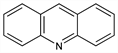
Dibenzo[
b,e]pyridine; 10-azaanthracene.
C
13H
9N; mol wt 179.22.
C 87.12%, H 5.06%, N 7.82%.
Description and references
Occurs in coal tar. Isoln: Graebe, Caro, Ann. 158, 265 (1871); from high boiling tar oils:
Wirth, DE 440771 (1926). Prepn from N-phenylanthranilic acid: Perkin, Clemo, GB 214756 (1923); from Ca-anthranilate: Koller, Krakauer, Monatsh. Chem. 50, 51 (1928) DOI; by passing benzylaniline vapor over red-hot
platinum wire: Meyer, Hofmann, ibid. 37, 698 (1916); cf. Ullmann, Ber. 40, 2521 (1907). Absorption spectrum: Pinnow, J. Prakt. Chem. [2] 66, 276 (1902). Toxicity: S. D. Rubbo, Br. J. Exp. Pathol. 28, 1 (1947). Reviews: A.
Albert, The Acridines (St. Martin's
Press, New York, 2nd ed., 1966); R. M. Acheson, Acridines (Interscience, New York, 2nd ed., 1973).
Properties
Pale yellow orthorhombic plates, needles from
diluted alcohol. Poisonous. There
are five crystalline forms of acridine all of which melt below 111°.
Purified acridine mp 110-111°; commercial samples mp 107° or mp 109°. Begins to
sublime at 100°. bp760 346°; also reported as bp760 >360°. Volatile with steam.
Slightly sol in boiling water, liquid ammonia, liquid sulphur dioxide;
sparingly sol in light petroleum; freely sol in alcohol, ether, hydrocarbons,
carbon disulfide. 1 gm sol in <1 ml boiling benzene or alcohol;
5 ml benzene (20°); 6 ml alcohol (20°); 16 ml of ether (20°); 1.8
ml boiling cyclohexane. d 1.27-1.28. Dilute solns of acridine and its salts have a violet and green
fluorescence, respectively. Weak base, colors litmus paper blue,
forms yellow crystalline salts with mineral acids. Forms colored
quaternary ammonium compounds (acridinium compounds), by the action
of alkyl and aryl halides and sulfates. LD50 s.c. in mice: 0.40 g/kg (Rubbo).Caution
Strongly irritating to skin, mucous
membranes. See: Clinical Toxicology
of Commercial Products, R. E. Gosselin et al., Eds. (Williams & Wilkins, Baltimore, 5th ed., 1984) Section
II, p 384.Use
Manuf dyes and intermediates; some dyes derived
from it are used as antiseptics, e.g. 9-aminoacridine, acriflavine
and proflavine. The hydrochloride has been used as reagent for cobalt,
iron and zinc.