225. Aldosterone
Nomenclature
Description and references
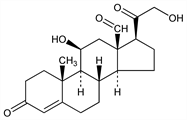
Adrenocortical steroid which exerts regulatory influence on metabolism of electrolytes and water. Isoln: Simpson et al., Experientia 9, 333 (1953); Helv. Chim. Acta 37, 1163 (1954); Mattox et al., J. Am. Chem. Soc. 75, 4869 (1953); Harman et al., ibid. 76, 5035 (1954). Solutions contain an equilibrium mixture of the aldehyde and the hemiacetal, the equilibrium favoring the latter. Structure: Tait et al., Experientia 10, 132 (1954); Helv. Chim. Acta 37, 1200 (1954). Crystal structure and molecular conformation: Duax, Hauptmann, J. Am. Chem. Soc. 94, 5467 (1972). 13C-NMR spectrum: P. Gerard, Org. Magn. Reson. 11, 478 (1978). Total synthesis: Schmidlin et al., Helv. Chim. Acta 40, 1438 (1957); Johnson et al., J. Am. Chem. Soc. 80, 2585 (1958); 85, 1409 (1963). Three-step synthesis from corticosterone: Barton, Beaton, ibid. 82, 2640 (1960); 83, 4083 (1961). Alternate synthesis: D. H. R. Barton et al., J. Chem. Soc. Perkin Trans. 1 1975, 2243; M. Miyano, J. Org. Chem. 46, 1846 (1981). Biosynthesized in the zona glomerulosa and transported chiefly by albumin. In man, 400 μg secreted normally in one day. Secretion influenced by ACTH, growth hormone, plasma sodium and potassium, and the renin-angiotensin system. Causes reabsorption of Na+, Cl, and HCO3 and diuresis of K+. Review: L. F. Fieser, M. Fieser, Steroids (Reinhold, New York, 1959) pp 701-720.
Properties
Hydrated crystals from dilute acetone, mp 108-112° (when anhydr mp 164°). [α]D23 +152.2° (anhydr; c = 2 in acetone). [α]D25 +161° (c = 0.1 in chloroform). uv max: 240 nm (log ε 4.20 for the monohydrate; εmol 15,000 for the anhydr).Derivative
21-Acetate.Description and references
Synthesis: Wettstein et al.; Jeger, US 3002972 and US 3014029 (both 1958 to Ciba).
Properties
Flat needles from acetone + ether, mp 198-199°. [α]D24 +121.7° (c = 0.71 in chloroform).Therapeutic Category
Mineralocorticoid.
Therapeutic Category (Veterinary)
Mineralocorticoid.Keywords
Mineralocorticoid