651. Angiotensin
Nomenclature
Description and references
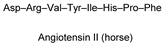
Formerly hypertensin and angiotonin. Pressor substance formed by the action of renin, q.v., on a plasma substrate, angiotensinogen (renin substrate, hypertensinogen). The substance so formed is a decapeptide called angiotensin I which is converted to the active pressor agent, angiotensin II, by the splitting off of the C-terminal His-Leu residues by the angiotensin converting enzyme (ACE) or angiotensinase. The octapeptide angiotensin II differs among species only in the amino acid residue in position 5 being either Val or Ile. See reviews for refs to isoln and synthesis. Angiotensin II acts directly on the adrenal gland to stimulate the release of aldosterone, q.v. Rapid liquid phase synthesis of a protected angiotensin II: S. Nozaki, I. Muramatsu, Bull. Chem. Soc. Jpn. 55, 2165 (1982). Extraction and characterization of angiotensins I and II from rat brain: D. Ganten et al., Science 221, 869 (1983). Reviews: M. Bodanszky, M. A. Ondetti, Peptide Synthesis (John Wiley, New York, 1966) pp 215-223; E. Schrder, K. Lübe, The Peptides vol. II (English ed., New York, 1966) pp 4-62; Bumpus, Smeby, “Angiotensin” in Renal Hypertension, I. Page, J. McCubbin, Eds. (Year Book Medical Publishers, Chicago, 1968) pp 62-98; Lee, “Angiotensin” in Renin and Hypertension (Williams & Wilkins, Baltimore, 1969) pp 32-94; G. M. Molinatti, P. Limone, Minerva Med. 72, 715-732 (1981); J. A. Oliver et al., Ann. N.Y. Acad. Sci. 394, 275-277 (1982); M. Marin-Grez, Biochem. Pharmacol. 31, 3941-3947 (1982). Symposium on hemodynamic effects of angiotensin II and its role in cardiovascular disease: Am. J. Hypertens. 15, Suppl. 1, S1-S27 (2002). See also Tonin.
Properties
Angiotensins are very stable. Hydrolyzed by strong acids and bases and above pH 9.5. Sol in organic solvents, in aq solns pH 5-8. In high dilution, lost by absorption on walls of glass vessels.Derivative
Amide.Nomenclature
Therapeutic Category
Amide as vasoconstrictor.
Keywords
Angiotensin Amide: Antihypotensive