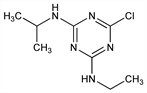
871. Atrazine
Nomenclature
CAS number: 1912-24-9
6-Chloro-N2-ethyl-N4-(1-methylethyl)-1,3,5-triazine-2,4-diamine; 2-chloro-4-ethylamino-6-isopropylamine-s-triazine; G-30027; AAtrex (Syngenta); Atranex (Makhteshim-Agan); Gesaprim (Syngenta). C8H14ClN5; mol wt 215.68.
C 44.55%, H 6.54%, Cl 16.44%, N 32.47%.
Description and references
Prepn: Gysin, Knüsli, CH 342784, CH 342785 (both 1960 to Geigy), C.A. 55, 5552d (1961); Mel'nikov et al., Khim. Prom. 1961, 703, C.A. 58, 526c (1963); Andriska et al., HU 149189 (1962 to Nehézvegyipari Kutato Intézet), C.A. 58, 13972c (1963); Mildner, FR 1317812 (1963 to Radonja Kemijska Ind.), C.A. 59, 8765h (1963). Toxicity study: S. Dalgaard-Mikkelsen, E. Poulsen, Pharmacol. Rev. 14, 225 (1962) PubMed. Review of toxicology and human exposure: Toxicological Profile for Atrazine (PB2004-100001, 2003) 262 pp.