962. Barbital
Nomenclature
CAS number: 57-44-3
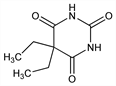
5,5-Diethyl-2,4,6(1H,3H,5H)-pyrimidinetrione; 5,5-diethylbarbituric acid; barbitone; diethylmalonylurea; Veronal. C8H12N2O3; mol wt 184.19.
C 52.17%, H 6.57%, N 15.21%, O 26.06%.
Description and references
Prototype of the barbiturate hypnotics. Prepn: M. Conrad, M. Guthzeit, Ber. 15, 2841 (1882); E. Fischer, A. Dilthey, Ann. 335, 334 (1904). Use as physiological buffer: L. Michaelis, J. Biol. Chem. 87, 33 (1930); in enzyme determn: J. Bergerman, Clin. Chem. 12, 797 (1966).
Properties
Faintly bitter needles (trigonal in the stable phase) from water, mp 188-192°. Can be sublimed in vacuo. pK (25°) 7.43. One gram dissolves in about 130 ml water, 13 ml boiling water, 14 ml alcohol, 75 ml chloroform, 35 ml ether. Sol in acetone, ethyl acetate, alkalies, petr ether, acetic acid, amyl alcohol, pyridine, aniline, nitrobenzene.Derivative
Sodium salt.Nomenclature
CAS number: 144-02-5
Barbital sodium; sodium 5,5-diethylbarbiturate; barbitone sodium; soluble barbital; sodium diethylmalonylurea; Veronal sodium; Medinal. C8H11N2NaO3; mol wt 206.17.
C 46.61%, H 5.38%, N 13.59%, Na 11.15%, O 23.28%.
Properties
Bitter crystals or powder. One gram dissolves in 5 ml water, 2.5 ml boiling water, 400 ml alc. Aq soln is alkaline to litmus and phenolphthalein. pH of 0.1 molar aq soln, 9.4.Note
This is a controlled substance (depressant): 21 CFR, 1308.14.Use
Biological buffer.Therapeutic Category
Sedative, hypnotic.
Therapeutic Category (Veterinary)
Sedative, hypnotic.Keywords
Sedative/Hypnotic; Barbituric Acid Derivatives