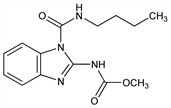
1044. Benomyl
Nomenclature
Description and references
Prepn: H. L. Klopping, FR 1523597; eidem, US 3631176 (1968, 1971 both to du Pont). The degradation product, methyl 2-benzimidazolecarbamate, is thought to be the active component; see carbendazim. Antifungal activity and mode of action studies: Kilgore, White, Bull. Environ. Contam. Toxicol. 5, 67 (1970); Maxwell, Brody, Appl. Microbiol. 21, 944 (1971); Bartels-Schooley, MacNeill, Phytopathology 61, 816 (1971). Activity as catalyst in biological oxidation of sewage and fertilizers: Kouba, US 3649530 (1972 to du Pont). Toxicity: E. W. Schafer, Toxicol. Appl. Pharmacol. 21, 315 (1972). Metabolism: J. A. Gardiner et al., J. Agric. Food Chem. 22, 419 (1974). Mutagenicity study: J. P. Seiler, Mutat. Res. 32, 151 (1975); H. Sherman et al., Toxicol. Appl. Pharmacol. 32, 305 (1975). Review: W. E. Bleidner et al., Anal. Methods Pestic. Plant Growth Regul. 10, 157-171 (1978).