1127. Benzyl Benzoate
Nomenclature
CAS number: 120-51-4
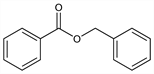
Benzoic acid phenylmethyl ester; benzoic acid benzyl ester; benzylbenzenecarboxylate; Acarosan (Allergopharma); Antiscabiosum (Strathmann); Ascabiol (RPR). C14H12O2; mol wt 212.24.
C 79.23%, H 5.70%, O 15.08%.
Description and references
Contained in Peru and Tolu balsams. Prepd by the action of sodium benzylate on benzaldehyde: Kamm, Kamm, Org. Synth. coll. vol. I, 104 (2nd ed., 1941); by the dry esterification of sodium benzoate and benzyl chloride in the presence of triethylamine: Thorp, Nottorf, Ind. Eng. Chem. 39, 1300 (1947). Toxicity studies: Graham, Kuizenga, J. Pharmacol. Exp. Ther. 84, 358 (1945); Draize et al., J. Pharmacol. Exp. Ther. 93, 26 (1948). Comprehensive description: M. M. A. Hassan, J. S. Mossa, Anal. Profiles Drug Subs. 10, 55-74 (1981).
Properties
Leaflets or oily liq; faint, pleasant, aromatic odor; sharp burning taste. mp 21°. d425 1.118. bp 323-324°. bp16 189-191°. bp4.5 156°. Sparingly volatile with steam. nD21 1.5681. Insol in water or glycerol. Miscible with alc, chloroform, ether, oils. LD50 in rats, mice, rabbits, guinea pigs (g/kg): 1.7, 1.4, 1.8, 1.0 orally (Draize).Caution
Direct contact may cause skin irritation. Potential symptoms of overexposure by ingestion in exptl animals are progressive incoordination, CNS excitation, convulsions. See Clinical Toxicology of Commercial Products, R. E. Gosselin et al., Eds. (Williams & Wilkins, Baltimore, 5th ed., 1984) Section II, p 203.Use
As solvent of cellulose acetate, nitrocellulose and artificial musk; substitute for camphor in celluloid and plastic pyroxylin compds; perfume fixative; in confectionery and chewing gum flavors.Therapeutic Category
Scabicide, pediculicide.
Therapeutic Category (Veterinary)
Acaricide, pediculicide. Contraindicated in cats.Keywords
Ectoparasiticide