1360. Brain Natriuretic Peptide
Nomenclature
Description and references
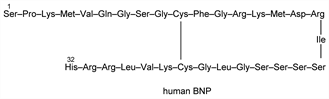
Peptide hormone structurally and physiologically similar to atrial natriuretic peptide, q.v. Originally discovered in mammalian brain, subsequently found to be produced primarily by the cardiac ventricle in response to hemodynamic stress. Amino acid sequence shows a marked interspecies diversity; the normal circulating form in humans contains 32 amino acid residues. Isoln from porcine brain: T. Sudoh et al., Nature 332, 78 (1988). Cloning of human BNP precursor: idem et al., Biochem. Biophys. Res. Commun. 159, 1427 (1989). Direct isoln from human heart: Y. Kambayashi et al., FEBS Lett. 259, 341 (1990). Use in prognosis of risk in acute coronary syndromes: J. A. de Lemos et al., N. Engl. J. Med. 345, 1014 (2001); in diagnosis of congestive heart failure: A. S. Maisel et al., ibid. 347, 161 (2002). Review: N. C. Davidson, A. D. Struthers, J. Hypertens. 12, 329-336 (1994); T. Takeda, M. Kohno, Hypertens. Res. 18, 259-266 (1995); of pathophysiological significance: M. Yoshibayashi et al., Eur. J. Endocrinol. 135, 265-268 (1996); of clinical experience: N. Valli et al., J. Lab. Clin. Med. 134, 437-444 (1999).
Derivative
Nesiritide.Nomenclature
Description and references
Clinical hemodynamic effects: L. S. Marcus et al., Circulation 94, 3184 (1996). Clinical trial in congestive heart failure: W. S. Colucci et al., N. Engl. J. Med. 343, 246 (2000).
Therapeutic Category
In treatment of congestive heart failure.