Nomenclature
CAS number: 71-36-3
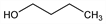
1-Butanol; butyl alcohol; propyl carbinol.
C
4H
10O; mol wt 74.12.
C 64.82%, H 13.60%, O 21.59%.
Description and references
Prepn by reduction of butyraldehyde with sodium
borohydride: Chaikin, Brown, J. Am. Chem.
Soc. 71, 122 (1949). Manuf from ethylene oxide
and triethylaluminum: Rudner, US 3091627 (1963 to Koppers); by oxidation
of tributylborane: Mirviss, US 3067235 (1962 to Esso). Manuf by carbohydrate
fermentation, by hydrogenation of butyraldehyde, from crotonaldehyde:
Faith, Keyes & Clark's Industrial Chemicals, F. A. Lowenheim, M. K. Moran, Eds. (Wiley-Interscience, New York,
4th ed., 1975) pp 178-185. Purification and vapor pressure: Biddiscombe et al., J. Chem. Soc. 1963, 1954. Toxicity study: H. F. Smyth et al. Arch. Ind. Hyg. Occup. Med. 4, 119 (1951).
Properties
Highly refractive liquid; burns with a strongly
luminous flame; leaves a transitory greasy spot on paper. Odor similar
to that of fusel oil, but weaker. d420 0.810. bp 117-118°. mp -90°. Flash pt 36-38°C. nD20 1.3993. A mixture of 63% of the alcohol and 37% water forms a constant
boiling mixture, boiling at 92°. Soly at 25°, 9.1 ml/100 ml H2O: Booth, Everson, Ind. Eng. Chem. 40, 1491 (1948). Miscible with alc, ether and many other
organic solvents. LD50 orally in rats: 4.36 g/kg (Smyth).Caution
Potential symptoms of overexposure
are irritation of eyes, nose and throat; headache, vertigo and drowsiness;
corneal inflammation, blurred vision, lacrimation and photophobia;
dermatitis; possible auditory nerve damage, hearing loss; CNS depression.
See NIOSH Pocket Guide to Chemical
Hazards (DHHS/NIOSH 97-140, 1997) p 38.Use
As organic solvent for fats, waxes, resins, shellac,
varnish, gums etc.; manuf lacquers, rayon, detergents, other butyl
compds; in microscopy for preparing paraffin imbedding materials.