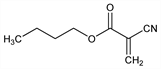
1565. n-Butyl Cyanoacrylate
Nomenclature
Description and references
Monomer rapidly polymerizes upon contact with fluid or tissue to form a strong, biodegradable adhesive. Preparative methods: A. E. Ardis, US 2467927 (1949 to B. F. Goodrich); C. H. McKeever, US 2912454 (1959 to Rohm & Haas). Prepn, polymerization and degradation: F. Leonard et al., J. Appl. Polym. Sci. 10, 259 (1966). Mechanism of polymerization and nanoparticle formation: N. Behan et al., Biomaterials 22, 1335 (2001). Characterization of polymer nanoparticles by particle size analysis: A. Bootz et al., Eur. J. Pharm. Biopharm. 57, 369 (2004); by MS: idem et al., ibid. 60, 391 (2005). Clinical experience in ophthalmic applications: A. B. Leahey et al., Ophthalmology 100, 173 (1993); in closure of surgical incisions: G. E. Amiel et al., J. Am. Coll. Surg. 189, 21 (1999). Clinical evaluation in augmentation rhinoplasty: M. E. Sachs, Arch. Otolaryngol. 111, 389 (1985); in management of bleeding gastric varices: B. D. Greenwald et al., Am. J. Gastroenterol. 98, 1982 (2003). Review of biomedical applications: C. Vauthier et al., Adv. Drug Delivery Rev. 55, 519-548 (2003).
Properties
Colorless liquid. bp1.8 68°. d20 0.989. n20D 1.4424. nD25 1.4410. Insol in water. Flash pt, closed cup: >176°F (>80°C). Vapor pressure (25°): <0.5 mmHg. Surface tension: 31.11 dynes/cm. Highly reactive with water and weak bases.Derivative
Polymer.Nomenclature
Use
Adhesive. Polymer nanoparticles as pharmaceutic aid for controlled release drug delivery.Therapeutic Category
Tissue adhesive.
Therapeutic Category (Veterinary)
Tissue adhesive.Keywords
Tissue Adhesive