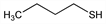
1577. n-Butyl Mercaptan
Nomenclature
Description and references
Formed by the action of yeast on a product obtained when hydrogen sulfide is made to react with butyraldehyde in alcoholic ammonia: Nord, Ber. 52, 1209 (1919); by passing vapors of butanol and hydrogen sulfide over thorium oxide catalyst: Kramer, Reid, J. Am. Chem. Soc. 43, 880 (1921); together with dibutyl sulfide in distilling an aq soln of sodium butyl sulfate and sodium sulfide: Gray, Gutekunst, J. Am. Chem. Soc. 42, 858 (1920); by slightly warming dithiocarbamic butyl ester with aq KOH: v. Braun, Engelbertz, Ber. 56, 1574 (1923); the sodium salt is formed when dibutyl disulfide is treated with sodium in ether or alcohol: Moses, Reid, J. Am. Chem. Soc. 48, 777 (1926). Physical properties: Mathias, ibid. 72, 1897 (1950); W. E. Haines et al., J. Phys. Chem. 60, 549 (1956). Once cited to occur in “skunk” fluid, see Beckmann, Pharm. Zentralhalle 37, 557 (1896); T. B. Aldrich, J. Exp. Med. 1, 323 (1896); however, recent literature rebuts this: K. K. Anderson, D. T. Bernstein, J. Chem. Ecol. 1, 493 (1975); eidem, J. Chem. Educ. 55, 159 (1978).