1836. 3-Carene
Nomenclature
CAS number: 13466-78-9
3,7,7-Trimethylbicyclo[4.1.0]hept-3-ene; Δ3-carene; 4,7,7-trimethyl-3-norcarene; isodiprene. C10H16; mol wt 136.23.
C 88.16%, H 11.84%.
Description and references
Constituent of turpentine. The turpentine from Pinus sylvestris L. may contain as much as 42%, turpentine from Pinus longifolia Roxb., Pinaceae about 30%. Isoln and structure: Simonsen, The Terpenes vol. II (Cambridge, 1949) pp 64-72; Guenther, The Essential Oils vol. II (Van Nostrand, 1949) pp 49-51. Conformation: Acharya, Tetrahedron Lett. 1966, 4117. Absorption spectrum: Cole, J. Chem. Soc. 1954, 3807.
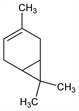
Derivative
d-Form.Properties
Mobile liquid. Readily oxidized on exposure to air. Sweet and pungent odor, more agreeable than the odor of turpentine. d1515 0.8668; d3030 0.8586. bp705 168-169°. bp200 123-124°. [α]D20 +7.69°. nD30 1.468. Practically insol in water. Miscible with fat solvents and oils.Derivative
d-Form nitrosate.C10H16N2O4; mol wt 228.25.
C 52.62%, H 7.07%, N 12.27%, O 28.04%.