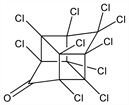
2083. Chlordecone
Nomenclature
CAS number: 143-50-0
1,1a,3,3a,4,5,5,5a,5b,6-Decachlorooctahydro-1,3,4-metheno-2H-cyclobuta[cd]pentalen-2-one; GC-1189; Kepone (Allied Chemical). C10Cl10O; mol wt 490.64.
C 24.48%, Cl 72.26%, O 3.26%.
Description and references
Prepn: Gilbert, Giolito, US 2616825 and US 2616928 (1952 to Allied Chem.); reissued as US RE 24435 (1958). Structure: McBee et al., J. Am. Chem. Soc. 78, 1511 (1956). Review: Ungnade, McBee, Chem. Rev. 58, 249-320 (1958). Toxicity data: T. B. Gaines, Toxicol. Appl. Pharmacol. 14, 515 (1969). Occupational exposure: Chem. Eng. News 54, 19 (Feb. 2, 1976). Comparative toxicity in man and animals: P. S. Guzelian, Annu. Rev. Pharmacol. Toxicol. 22, 89-113 (1982). Review of toxicology and human exposure: Toxicological Profile for Mirex and Chlordecone (PB95-264354, 1995) 362 pp.