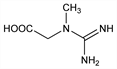
2568. Creatine
Nomenclature
Description and references
Amino acid that participates in the transfer of high energy phosphate in muscle cells. Predominantly found in skeletal and cardiac muscle; occurring also in its phosphorylated form, see phosphocreatine. Produced by liver, pancreas and kidneys by the transfer of the guanidine moiety of arginine to glycine which is then methylated to give creatine. First identified in meat extracts by Chevreul in 1835; name derived from the Greek “kreas,” meaning flesh. Synthesis by heating cyanamide with sarcosine: Strecker, Jahresber. Chem. 1868, 686; cf. Volhard, Z. Chem. 5, 318 (1869); Paulmann, Arch. Pharm. 232, 638 (1894); Bergmann, Zervas, Z. Physiol. Chem. 173, 80 (1928); King J. Chem. Soc. 1930, 2374. Use in diagnosis of myocardial infarction: J. Delanghe et al., Ann. Clin. Biochem. 25, 383 (1988). HPLC determn in cardiac muscle: T. Teerlink et al., Anal. Biochem. 214, 278 (1993). Review of role in energy metabolism: S. P. Bessman, C. L. Carpenter, Annu. Rev. Biochem. 54, 831-862 (1985). Review of efficacy and safety as nutritional supplement: A. S. Graham, R. C. Hatton, J. Am. Pharm. Assoc. 39, 803-810 (1999); of effects of dietary supplementation on exercise performance: T. W. Demant, E. C. Rhodes, Sports Med. 28, 49-60 (1999); A. Casey, P. L. Greenhaff, Am. J. Clin. Nutr. 72, Suppl., 607S-617S (2000).