2607. Cryptophycins
Description and references
Cytotoxic, cyclic depsipeptides isolated from blue-green algae Nostoc sp. Named for their antifungal activity against the genus Cryptococcus sp. The parent compound is cryptophycin-1; at least 21 other naturally-occurring cryptophycins have been isolated; many other analogs have been synthesized. Interacts with the Vinca alkloid binding domain of tubulin. Isoln: C. F. Hirsch et al., GB 2220657; eidem, US 4946835 (both 1990 to Merck & Co.); R. E. Schwartz et al., J. Ind. Microbiol. 5, 113 (1990). Prepn: R. E. Moore et al., WO 9640184; eidem, US 6013626 (1996, 2000 both to Univ. of Hawaii and Wayne State Univ.). Structure determn: G. Trimurtulu et al., J. Am. Chem. Soc. 116, 4729 (1994); and stability and antitumor evaluation: idem et al., ibid. 117, 12030 (1995). Mechanism of action: C. D. Smith, X. Zhang, J. Biol. Chem. 271, 6192 (1996); D. Panda et al., Proc. Natl. Acad. Sci. USA 95, 9313 (1998). Effect on tubulin ring structures: N. R. Watts, et al., Biochemistry 41, 12662 (2002). Review of syntheses: M. A. Tius, Tetrahedron 58, 4343-4367 (2002); and anticancer activity: M. Eggen, G. I. Georg, Med. Res. Rev. 22, 85-101 (2002).
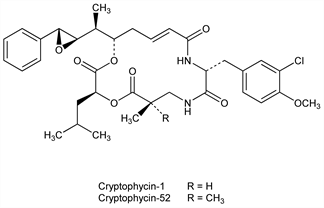
Derivative
Cryptophycin-52.Nomenclature
Description and references
Synthetic cryptophycin analog under investigation for treatment of solid tumors. Enantioselective synthesis: A. K. Ghosh, L. Swanson, J. Org. Chem. 68, 9823 (2003). Clinical evaluation in lung cancer: M. J. Edelman et al., Lung Cancer 39, 197 (2003); in platinum-resistant ovarian cancer: G. D'Agostino et al., Int. J. Gynecol. Cancer 16, 71 (2006).