Nomenclature
CAS number: 108-80-5
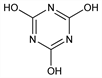
1,3,5-Triazine-2,4,6(1
H,3
H,5
H)-trione;
sym-triazinetriol; 2,4,6-trihydroxy-1,3,5-triazine; tricyanic acid; trihydroxycyanidine.
C
3H
3N
3O
3; mol wt 129.07.
C 27.92%, H 2.34%, N 32.56%, O 37.19%.
Description and references
Prepn: Schmidt, J.
Prakt. Chem. [2] 5, 41-52 (1872);
Venable, Moore, J. Am. Chem. Soc. 39, 1752 (1917). HPLC determn: P. Beilstein et
al., J. Agric. Food Chem. 29, 1132 (1981); in urine and pool water: T. V. Briggle et al., J. Assoc. Off. Anal. Chem. 64, 1222 (1981). Review of prepn, properties and uses:
E. M. Smolin, L. Rapoport, “s-Triazines and Derivatives”
in The Chemistry of Heterocyclic Compounds vol. 13, A. Weissberger, Ed.(Interscience, New York,
1959) pp 17-48; of chemistry, toxicity and antibacterial activity
as applied to swimming pools: E. Canelli, Am. J. Public Health 64, 155-162 (1974); F.
W. Linda, R. C. Hollenbach, J. Environ. Health 40, 324-329 (1978); of toxicology: B. G. Hammond et al., Environ. Health Perspect. 69, 287-292 (1986). Review: J. A. Wojtowicz
in Kirk-Othmer Encyclopedia of Chemical Technology vol. 7 (John Wiley & Sons, 4th ed., 1993) pp 834-851.
Properties
White crystalline solid; does not melt up to 330°,
sublimes and dissociates to isocyanic acid at higher temps. pKa1 6.88; pKa2 11.40; pKa3 13.5. uv max (0.1M HCl): 214 nm (log ε
3.38). uv max (0.1M phosphate
buffer pH 7): 214 nm (log ε
4.00). uv max (0.1M NaOH) 213 nm (log ε 4.64). Slightly
sol in common organic solvents such as acetone, benzene, diethyl ether,
ethanol, hexane. Soly (%): DMF 7.2; DMSO 17.4. Soly in water (%):
0.2 at 25°; 2.6 at 90°; 10.0 at 150°. Soly in 96% H2SO4 (25°): 14.1%. Sol in hot alcohols, pyridine, concd HCl
without decompn; in aq solns of NaOH and KOH. Insol in cold methanol,
ether, acetone, benzene, chloroform. Forms dihydrate in aq soln;
crystallizes as colorless monoclinic prisms that effloresce in dry
air. d25 1.75 (anhydr); d25 1.66 (dihydrate). Predominant tautomeric form in solid
state and soln is keto form, isocyanuric acid; in basic soln the enol form is more stable. LD50 orally in rats:
>5.00 g/kg (Canelli).Use
Convenient lab source of cyanic acid gas. In prepn
of melamine, sponge rubber, herbicides, dyes, resin, antimicrobial
agents. As stabilizer and disinfectant in swimming pool water.