Nomenclature
CAS number: 50-29-3
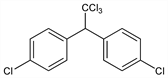
1,1′-(2,2,2-Trichloroethylidene)bis[4-chlorobenzene]; 1,1,1-trichloro-2,2-bis(
p-chlorophenyl)ethane; α,α-bis(
p-chlorophenyl)-β,β,β-trichlorethane; dichlorodiphenyltrichloroethane; chlorophenothane; clofenotane; dicophane; pentachlorin;
p,p′-DDT; Gesapon; Gesarex; Gesarol.
C
14H
9Cl
5; mol wt 354.49.
C 47.43%, H 2.56%, Cl 50.01%.
Description and references
Polychlorinated nondegradable pesticide; has
been used as an ectoparasiticide. Prepn: Zeidler, Ber. 7, 1180 (1874); P. Müller, US 2329074 (1944 to Geigy); Rueggeberg, Torrans, Ind. Eng. Chem. 38, 211 (1946); Cook et al., ibid. 39, 868, 1683 (1947). Convenient
lab procedures: Bailes, J. Chem. Educ. 22, 122 (1945); Ginsburg, Science 108, 339 (1948). Large scale production: Mosher et al., Ind. Eng. Chem. 38, 916 (1946). Chemical composition of technical grade:
H. L Haller et al., J. Am. Chem.
Soc. 67, 1591 (1945). Activity: P. Müller, Helv. Chim. Acta 29, 1560 (1946).
Comprehensive monograph (in English and German): DDT, P. Müller, Ed., 3 vols (Birkh"auser Verlag, Basel and Stuttgart,
1955). Toxicity data: Gaines, Toxicol. Appl.
Pharmacol. 2, 88 (1960); 14, 515
(1969). Review of toxicology and human exposure: Toxicological Profile for DDT, DDE, DDD (PB2003-100137,
2002) 497 pp; of toxicology and environmental impact: V. Turusov et al., Environ. Health Perspect. 110, 125-128 (2002).
Properties
Biaxial elongated tablets, needles from 95% alc.
mp 108.5-109°. uv max (95% alc): 236 nm. Vapor pressure at 20° = 1.5 × 10⁻⁷ mm
Hg. Practically insol in water, dil acids, alkalies. Soly (g/100
ml): acetone 58; benzene 78; benzyl benzoate 42; carbon tetrachloride
45; chlorobenzene 74; cyclohexanone 116; 95% alc 2; ethyl ether 28;
gasoline 10; isopropanol 3; kerosene 8-10; morpholine 75; peanut oil
11; pine oil 10-16; tetralin 61; tributyl phosphate 50; freely sol
in pyridine, dioxane. The soly in organic solvents increases sharply
with a rise in temp. Resistant to destruction by light and oxidation.
Its unusual stability has resulted in difficulties in residue removal
from water, soil and foodstuffs. Should not be kept in iron containers
and should not be mixed with iron and aluminum salts nor with alkaline
substances. High storage temps should also be avoided. Setting point
of technical grade: 88.6-91.4°. LD50 in male, female rats (mg/kg): 113, 118 orally (Gaines, 1960).Caution
Poisoning may occur by ingestion
or by absorption through skin or respiratory tract. Potential symptoms
of overexposure are numbness, paresthesias, malaise, headache, sore
throat, fatigue, weakness, coarse tremors, convulsions and coma; death
due to respiratory failure. See Clinical Toxicology of Commercial Products, R. E. Gosselin et al., Eds. (Williams & Wilkins, Baltimore, 5th ed., 1984)
Section III, pp 134-138. This substance is reasonably anticipated
to be a human carcinogen: Report on Carcinogens,
Eleventh Edition (PB2005-104914, 2004) p III-89.Use
Contact insecticide.