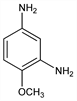
2976. 2,4-Diaminoanisole
Nomenclature
CAS number: 615-05-4
4-Methoxy-1,3-benzenediamine; 4-methoxy-m-phenylenediamine; 2,4-DAA; 4-MMPD; C.I. 76050; C.I. Oxidation Base 12. C7H10N2O; mol wt 138.17.
C 60.85%, H 7.29%, N 20.27%, O 11.58%.
Description and references
Prepd by reduction of 2,4-dinitroanisole with iron and acetic acid: DE 258653 (1912 to BASF), Frdl. 11, 392 (1912-14). Alternate prepn: K. Fries, Ann. 454, 147 (1927). Prepn of hydrochloride: F. Kehrmann, Ber. 50, 562 (1917). Mutagenicity studies: B. N. Ames et al., Proc. Natl. Acad. Sci. USA 72, 2423 (1975); D. J. N. Hossack, J. C. Richardson, Experientia 33, 377 (1977); W. G. H. Blijleven, Mutat. Res. 48, 181 (1977). Toxicity studies: C. Burnett et al., Food Cosmet. Toxicol. 13, 353 (1975); eidem, J. Toxicol. Environ. Health 1, 1027 (1976); eidem, ibid. 2, 657 (1977); G. K. Lloyd et al., Food Cosmet. Toxicol. 15, 607 (1977).
Properties
Needles from ether, mp 67-68°. Darkens on exposure to light. LD50 of an aq soln containing 0.05% Na2SO3: 460 mg/kg orally in rats (Lloyd).Derivative
Sulfate.Nomenclature
CAS number: 39156-41-7
4-MMPDS. C7H10N2O.H2SO4; mol wt 236.25.
C 35.59%, H 5.12%, N 11.86%, O 33.86%, S 13.57%.