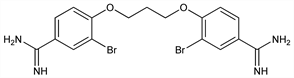
3024. Dibromopropamidine
Nomenclature
CAS number: 496-00-4
4,4′-[1,3-Propanediylbis(oxy)]bis(3-bromobenzenecarboximidamide); 4,4′-(trimethylenedioxy)bis(3-bromobenzamidine); 2′,2″-dibromo-4′,4″-diamidino-1,3-diphenoxypropane. C17H18Br2N4O2; mol wt 470.16.
C 43.43%, H 3.86%, Br 33.99%, N 11.92%, O 6.81%.
Description and references
Prepn: S. S. Berg, G. Newbery, GB 598911 (1948 to May & Baker); eidem, J. Chem. Soc. 1949, 642. Antibacterial activity: R. Wien et al., Lancet 254, 711 (1948); A. D. Russell, J. R. Furr, Int. J. Pharm. 34, 115 (1986). Mode of action: W. Woodside, Microbios 8, 23 (1973). Clinical use in Acanthamoeba keratitis: J. J. Wiens, W. B. Jackson, Can. J. Ophthalmol. 23, 107 (1988). HPLC determn in cosmetics: B. Wyhowski de Bukanski, M. O. Masse, Int. J. Cosmet. Sci. 6, 283 (1984).
Derivative
Isethionate.Nomenclature
CAS number: 614-87-9
Brolene Ointment (RPR); Brulidine (M & B). C21H30Br2N4O10S2; mol wt 722.42.
C 34.91%, H 4.19%, Br 22.12%, N 7.76%, O 22.15%, S 8.88%.
Properties
Prismatic needles from ethanol, mp 226°. Freely sol in water. One gram dissolves in 2 ml of water at 20°, in 60 g of 95% alcohol at 20°. Sol in glycerol. Practically insol in ether, chloroform, fixed oils, liquid petrolatum. Aq solns are very slightly acidic. Solns may be sterilized by heating at 100° for 30 min, but they should not be stored for more than a few days, and then only in neutral glass containers since some hydrolysis occurs with the formation of sparingly sol urea derivs. Incompat. with chlorides, sulfates, and many organic anions, all of which form sparingly sol salts.Use
Preservative in cosmetics.Therapeutic Category
Antiseptic; antiamebic.
Therapeutic Category (Veterinary)
Antiseptic, antimicrobial.Keywords
Antiamebic; Antiseptic/Disinfectant