Nomenclature
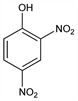
CAS number: 51-28-5
α-Dinitrophenol; Aldifen.
C
6H
4N
2O
5; mol wt 184.11.
C 39.14%, H 2.19%, N 15.22%, O 43.45%.
Description and references
Prepd by the action of NaOH on 1-chloro-2,4-dinitrobenzene.
Crystal and molecular structure: F. Iwasaki, Y. Kawano, Acta Crystallogr. 33B, 2455 (1977).
Toxicity data: E. W. Schafer, Toxicol. Appl.
Pharmacol. 21, 315 (1972). Review of toxicology
and human exposure: Toxicological Profile
for Dinitrophenols (PB95-264339, 1995) 262 pp.
Properties
Yellowish to yellow orthorhombic crystals. d 1.683. mp 112-114°. Sublimes when carefully
heated. Volatile with steam. Very sparingly sol in cold water; soly
in water (g/100 g of satd soln): at 54.5° = 0.137; at 75.8° = 0.301;
at 87.4° = 0.587; at 96.2° = 1.22. Soly at 15° (g/100 g soln): Ethyl
acetate 15.55; acetone 35.90; chloroform 5.39; pyridine 20.08; carbon
tetrachloride 0.423; toluene 6.36. Sol in alcohol, benzene, aq alkaline
solns. Forms crystalline sodium salt which is sol in water. LD50 orally in rats:
30 mg/kg (Schafer).Caution
Rapidly absorbed through GI tract,
respiratory tract and intact skin. Potential symptoms of overexposure
are marked fatigue, tremendous thirst, profuse sweating, flushing
of face; nausea, vomiting, abdominal pain, diarrhea; restlessness,
anxiety, excitement; rise in body temperature; tachycardia, hyperpnea,
dyspnea, cyanosis, muscle cramps; kidney and liver injury. See Clinical Toxicology of Commercial Products, R. E. Gosselin et al., Eds. (Williams & Wilkins,
Baltimore, 5th ed., 1984) Section III, pp 156-159.Use
Manuf dyes, diaminophenol, wood preservative, insecticide;
also as indicator. pH range: 2.6 colorless, 4.4 yellow. Reagent
for the detection of potassium and ammonium ions.