Nomenclature
CAS number: 110-80-5
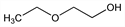
Ethylene glycol monoethyl ether; Cellosolve; Oxitol.
C
4H
10O
2; mol wt 90.12.
C 53.31%, H 11.18%, O 35.51%.
Description and references
Manuf from ethylene oxide and ethanol: Faith, Keyes & Clark's Industrial Chemicals, F. A. Lowenheim, M. K. Moran, Eds. (Wiley-Interscience, New York,
4th ed., 1975) pp 403-407. Toxicity data: H. F. Smyth et al., J. Ind. Hyg. Toxicol. 23, 259 (1941). Series of articles on toxicology: Environ. Health Perspect. 57,
1-275 (1984).
Properties
Colorless, practically odorless liquid. d2020 0.931. bp 135°.
mp -70°. Flash pt, closed cup: 112°F (44°C); open cup: 120°F (49°C). nD25 1.406. Misc with water, alc,
ether, acetone, liquid esters. It dissolves many oils, resins, waxes,
etc. LD50 orally in rats: 3 g/kg (Smyth).Caution
Potential symptoms of overexposure
in exptl animals are irritation of eyes, respiratory system; blood
changes; liver, kidney, lung damage; reproductive, teratogenic effects.
See NIOSH Pocket Guide to Chemical
Hazards (DHHS/NIOSH 97-140, 1997) p 130. See also Patty's Industrial Hygiene and Toxicology vol. 2D, G. D. Clayton, F. E. Clayton, Eds. (Wiley-Interscience,
New York, 4th ed., 1994) pp 2765, 2777-2785.Use
Solvent for nitrocellulose, lacquers and dopes;
in varnish removers, cleansing solns, dye baths; finishing leather
with water pigments and dye solns; increasing stability of emulsions.