4080. Filipin
Nomenclature
Description and references
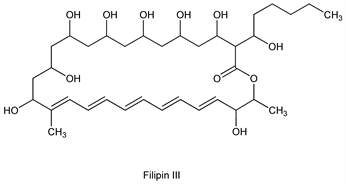
Polyene antibiotic complex containing at least eight pentaene compounds, which has been resolved into three pure components, filipin II, III (major), and IV, which differ in the number of hydroxyl groups present (8, 9, 9, resp.) and filipin I, a mixture of at least 5 components. Described as a single entity in the earlier literature. Initial isolation from Streptomyces filipenensis in Philippine soil: Whitfield et al., J. Am. Chem. Soc. 77, 4799 (1955). Early structural work: Dhar et al., Proc. Chem. Soc. London 1960, 310; Djerassi et al., Tetrahedron Lett. 1961, 383; Golding, Rickards, ibid. 1964, 2615; Dhar et al., J. Chem. Soc. 1964, 842; Ceder, Ryhage, Acta Chem. Scand. 18, 588 (1964). Separation of filipin complex into components: Bergy, Eble, J. Antibiot. 23, 414 (1970); see also Rickards et al., ibid. 603. Mechanism of action: R. W. Holz in Antibiotics vol. 5, pt. 2, F. E. Hahn, Ed. (Springer-Verlag, New York, 1979) pp 313-340. Filipin also interacts specifically with 3β-hydroxysterols (e.g. cholesterol): P. M. Elias et al., J. Histochem. Cytochem. 27, 1247 (1979); see also N. J. Severs, H. J. Simons, Nature 303, 637 (1983).
Properties
Yellow, feathery needles from chloroform, mp 195-205°. Sensitive to air. [α]D22 148.3° (c = 0.89 in methanol). uv max (methanol): 322, 338, 355 nm (E1%1cm 910, 1360, 1330). Freely sol in DMF, pyridine. Also sol in 95% ethanol, methanol, butanol, isopropanol, glacial acetic acid, ether. Practically insol in water, chloroform.Derivative
Filipin III.Nomenclature
Properties
Isomeric with filipin IV. Crystals from propanol, mp 163-180° (Bergy, Eble). [α]D25 245° (c = 0.8 in DMF). uv max (methanol): 243, 308, 321, 337, 354 nm (E1%1cm 62, 413, 851, 1368, 1343).Use
Produces arthritis rapidly in rabbits: Pras, Weissman, Drug Trade News, July 4, 1966, p 40; as a sterol probe in freeze-fracture cytochemistry.Therapeutic Category
Antifungal.
Keywords
Antifungal (Antibiotics); Polyenes