4383. Gellan Gum
Nomenclature
Description and references
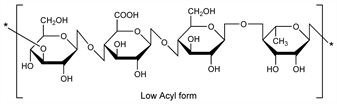
Extracellular polysaccharide obtained by aerobic fermentation of Pseudomonas elodea. Anionic hydrocolloid composed of acetylated linear tetrasaccharide repeat unit β-d-glucose, β-d-glucuronic acid and α-l-rhamnose in a 2:1:1 molar ratio. Prepn of native form: K. S. Kang, G. T. Veeder, US 4326053; of deacetylated form: K. S. Kang et al., US 4326052 (both 1982 to Merck & Co.); R. Moorhouse et al., ACS Symp. Ser. 150, 111 (1981). Structural studies: M. A. O'Neill et al., Carbohydr. Res. 124, 123 (1983); P.-E. Jansson et al., ibid. 135. Gelation properties: H. Grasdalen, O. Smidsrod, Carbohydr. Polym. 7, 371 (1987). Texture profile analysis: G. R. Sanderson et al. in Gums and Stabilizers for the Food Industry vol. 4, G. O. Phillips et al., Eds. (IRL Press, Oxford, 1988) pp 219-229. Determn in food gels: J. K. Baird, W. W. Smith, Food Hydrocolloids 3, 407 (1989); in food products: H. D. Graham, ibid. 435 (1990). Use as agar substitute in culture media: D. Shungu et al., Appl. Environ. Microbiol. 46, 840 (1983). Physicochemical properties: M. Milas et al., Biopolymers 30, 451 (1990). Rheological study: P. B. Deasy, K. J. Quigley, Int. J. Pharm. 73, 117 (1991). Comparative review of gelling agents: G. R. Sanderson et al., Cereal Foods World 34, 991-998 (1989). Reviews: G. R. Sanderson in Food Gels, P. Harris, Ed. (Elsevier Appl. Sci., London, 1990) pp 201-232; W. Gibson in Thickening and Gelling Agents in Food, A. Imeson, Ed. (Blackie Academic & Professional, London, 1992) pp 227-249.