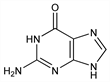
4564. Guanine
Nomenclature
CAS number: 73-40-5
2-Amino-1,7-dihydro-6H-purin-6-one; 2-aminohypoxanthine. C5H5N5O; mol wt 151.13.
C 39.74%, H 3.33%, N 46.34%, O 10.59%.
Description and references
Constituent of nucleic acids; widespread in animal and plant kingdom. First isolated from guano. Syntheses: Fisher, Ber. 30, 2226 (1897); Traube, ibid. 33, 1371 (1900); DE 134984 (1903); DE 158591 (1903); DE 162336 (1904). Prepn of 15N-isotopic guanine following Traube's synthesis: Plentl, Schoenheimer, J. Biol. Chem. 153, 203 (1944). Several desmotropic forms. Crystal structure of hydrochloride monohydrate: Broomhead, Acta Crystallogr. 4, 92 (1951). Reviews: Shapiro, Prog. Nucleic Acid Res. Mol. Biol. 8, 73-112 (1968); Ts'o, “Bases, Nucleosides and Nucleotides” in Basic Principles in Nucleic Acid Chemistry vol. 1, P. O. P. Ts'o, Ed. (Academic Press, New York, 1974) pp 453-584.
Properties
Usually amorphous. Small rhombic crystals by slow evaporation of aq soln contg large excess of NH3. Dec above 360° with partial sublimation. uv max (pH 6.2): 246, 275 nm (ε × 103 10.7, 8.1). Freely sol in ammonia water, aq KOH solns, dil acids; sparingly sol in alcohol, ether. Almost insol in water. pKb 3.22; pKa 9.92, detd at 40°. Many compds with acids, bases and metals have been prepared.Derivative
Hydrochloride monohydrate.C5H5N5O.HCl.H2O; mol wt 205.60.
C 29.21%, H 3.92%, N 34.06%, O 15.56%, Cl 17.24%.