4570. 5′-Guanylic Acid

Nomenclature

CAS number: 85-32-5
Guanosine 5′-monophosphate; GMP; guanosine 5′-phosphate; guanine riboside-5-phosphoric acid.
C10H14N5O8P; mol wt 363.22.
C 33.07%, H 3.89%, N 19.28%, O 35.24%, P 8.53%.

Description and references

Nucleotide widely distributed in nature; found in hydrolyzates of RNA. Isolated together with inosinic acid from sardines or yeast extract: Kuninaka et al., New Food Ind. 3, no. 1, 21 (1961). Also by direct biosynthesis using microorganisms or enzymes: Abrams, Bentley, Arch. Biochem. Biophys. 79, 91 (1959); Magasanik, Karibian, J. Biol. Chem. 235, 2672 (1960); Okumura et al., US 3249511 (1966). Chemical synthesis: Michelson, Todd, J. Chem. Soc. 1949, 2483; Chambers et al., J. Am. Chem. Soc. 79, 3747 (1957); Gilham, Tener, Chem. Ind. (London) 1959, 542; Tener, J. Am. Chem. Soc. 83, 159 (1961); Koransky et al., Z. Naturforsch. 17B, 291 (1962). Prepn of Na salt: Ishibashi, Ito, US 3190877 (1965 to Takeda). Monograph on synthesis of nucleotides: G. R. Pettit, Synthetic Nucleotides vol. 1 (Van Nostrand Reinhold, New York, 1972) 252 pp. Reviews: See Guanidine.
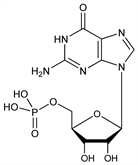
Chemical structure

Properties

Microcrystals, dec 190-200°. Sparingly sol in cold water.

Derivative

Barium salt octahydrate.
C10H12N5O8PBa.8H2O; mol wt 642.65.
C 18.69%, H 4.39%, N 10.90%, O 39.83%, P 4.82%, Ba 21.37%.

Properties

White powder. uv max (pH 2): 256 nm (ε 12400); (pH 12): 260 nm (ε 12100).

Derivative

Disodium salt monohydrate.
C10H12N5O8PNa2.H2O; mol wt 425.20.
C 28.25%, H 3.32%, N 16.47%, O 33.87%, P 7.28%, Na 10.81%.

Properties

Hygroscopic crystals, decomp at about 250°. Characteristic meaty taste. aM (molar absorbancy): 13.7 × 10³ at 252.5 nm (pH 7). Soly in water at 25° about 25 g/100 ml. Practically insol in alcohol, acetone, ether.

Use

The disodium salt as flavor intensifier, like sodium inosinate and sodium glutamate. Said to be more effective than either.