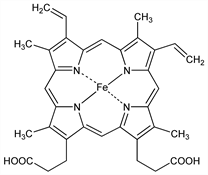
4639. Heme
Nomenclature
Description and references
Heme occurs free in tissues in the presence of certain pathological conditions, and in normal tissues; it occurs as the prosthetic group of a number of hemoproteins. It has been identified as the prosthetic group of hemoglobins, erythrocruorins (the hemoglobin analog of many invertebrates), myoglobins, some peroxidases, catalases, and cytochromes b. It is the color-furnishing portion of hemoglobin. Obtained when a soln of hematin in alkali is reduced in absence of nitrogenous substances: Bertin-Sans, de Moitessier, Compt. Rend. 114, 923 (1892); Dhéré et al., ibid. 165, 515 (1917). Synthesis: Fischer-Orth, Die Chemie des Pyrrols II, 1, 384 (Leipzig, 1937). Biosynthesis: Shemin, Naturwissenschaften 57, 185 (1970). Review: J. E. Falk, Porphyrins and Metalloporphyrins (Elsevier, NewYork, 1964) pp 8, 94, 183. Comprehensive monograph: Chance et al., Hemes and Hemoproteins (Academic Press, New York, 1966) 624 pp; Handbook of Experimental Pharmacology vol. 44, entitled “Heme and Hemoproteins”, F. DeMatteis, W. N. Aldridge, Eds. (Springer-Verlag, New York, 1978) 449 pp.