4653. Heparin
Nomenclature
Description and references
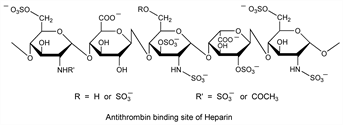
Glycosaminoglycan with anticoagulant activity. Heterogenous mixture of variably sulfated polysaccharide chains composed of repeating units of d-glucosamine and either l-iduronic or d-glucuronic acids. Mol wt ranges from 6000-30000 Da. Biosynthesized and stored in mast cells of various animal tissues, particularly liver, lung or gut. Commercial heparin is isolated from beef lung or pork intestinal mucosa. Isoln from mammalian tissue: Howell, Am. J. Physiol. 63, 434 (1922-23); 71, 553 (1924-25); Korn, J. Biol. Chem. 234, 1325 (1959); L. B. Jaques, Can. J. Biochem. Physiol. 37, 1183 (1959); J. A. Bush et al., US 2884358 (1959 to So. Calif. Gland). Purification: G. Nominé et al., US 2989438 (1961 to UCLAF); Toccaceli, US 3016331 (1962 to Ormonoterapia Richter); L. Roden et al., Methods Enzymol. 26, 73 (1972). Structural studies: M. L. Wolfrom, J. Am. Chem. Soc. 72, 5796 (1950); Velluz et al., Compt. Rend. 247, 1521 (1958); M. L. Wolfrom et al., J. Org. Chem. 29, 540 (1964). Configuration of glycosidic linkages: M. L. Wolfrom et al., ibid. 31, 1173 (1966); A. S. Perlin et al., Can. J. Chem. 48, 2260 (1970); T. Helting, U. Lindahl, J. Biol. Chem. 246, 5442 (1971). Identification of l-iduronic acid residues: A. S. Perlin et al., Carbohydr. Res. 7, 369 (1968). Antithrombotic activity results from the binding and activation of antithrombin III, a plasma protein which inhibits several enzymes in the coagulation cascade: R. D. Rosenberg, Fed. Proc. 36, 10 (1977). Anticoagulant activity is related to the mol wt of the polysaccharide fragments; low molecular weight components exhibit decreased hemorrhagic effects while retaining antithrombin binding ability: L.-O. Andersson et al., Thromb. Res. 15, 531 (1979); T. W. Barrowcliffe et al., Br. J. Haematol. 41, 573 (1979); J. Hirsch et al., Semin. Thromb. Hemostasis 11, 13 (1985). Characterization of the antithrombin binding site: U. Lindahl et al., Proc. Natl. Acad. Sci. USA 76, 3198 (1979); J. Choay et al., Thromb. Res. 18, 573 (1980). Synthesis of the pentasaccharide corresponding to the binding site sequence: eidem, Biochem. Biophys. Res. Commun. 116, 492 (1983). Symposium on structure, activity and clinical applications: Fed. Proc. 36, 9-116 (1977). Review of mechanism of action: I. Bjrk, U. Lindahl, Mol. Cell. Biochem. 48, 161-182 (1982); of structure-activity relationships and prepn of low mol wt fractions: B. Casu, Adv. Carbohydr. Chem. Biochem. 43, 51-134 (1985); of biosynthesis: U. Lindahl et al., Trends Biochem. Sci. 11, 221-225 (1986). Comprehensive description: F. Nachtmann et al., Anal. Profiles Drug Subs. 12, 215-276 (1983). Overview of clinical results in pulmonary embolism and venous thrombosis: R. Collins et al., N. Engl. J. Med. 318, 1162-1170 (1988); J. Hirsh, ibid. 324, 1565-1574 (1991); of clinical studies with low mol wt heparinoids: H. ten Cate et al., Am. J. Hematol. 27, 146-153 (1988).
Properties
Heparin has a rotation of [α]D20 +55°.Derivative
Calcium salt.Nomenclature
Derivative
Magnesium salt.Nomenclature
Properties
Sol in water. Insol in organic solvents.Derivative
Potassium salt.Nomenclature
Derivative
Sodium salt.Nomenclature
Properties
White to grayish-brown amorphous powder. Odorless, hygroscopic. [α]D25 +47° (c = 1.5 in water). One gram dissolves in 20 ml water. Sol in saline soln. Practically insol in alcohol, acetone, benzene, chloroform, ether. pH of 1% aq soln = 6.0 to 7.5. Absorption spectrum: Burson et al., J. Am. Chem. Soc. 78, 5874 (1956). Ampuled solns may be stored at room temp for at least 12 months. Commercially available ampuled, sterile solns contain 0.5% phenol or chlorobutanol as preservative.Therapeutic Category
Anticoagulant.
Therapeutic Category (Veterinary)
Anticoagulant.Keywords
Anticoagulant