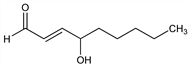
4726. HNE
Nomenclature
Description and references
Toxic aldehyde formed during lipid peroxidation in response to oxidative stress. Reacts primarily with the amino acids His or Lys to form an adduct which may alter protein function. Increased levels of the HNE-adduct are seen in Alzheimer's disease and after ozone exposure. Identification of cytotoxic activity of lipid oxidative products: E. Schauenstein, H. Esterbauer, Monatsh. Chem. 94, 164 (1963). Prepn: H. Esterbauer, W. Weger, ibid. 98, 1994 (1967). Synthesis: H. W. Gardner et al., Lipids 27, 686 (1992). Quantitative analysis by uv, GC/MS, HPLC: M. Kinter in Free Radicals N. A. Punchard, F. J. Kelly, Eds. (IRL Press, Oxford, UK, 1996) pp 133-145. Cytotoxicity: A. Benedetti et al., Biochim. Biophys. Acta 620, 281 (1980). Structural definition of adduct sites: D. V. Nadkarni, L. M. Sayre, Chem. Res. Toxicol. 8, 284 (1995); by MS: M. S. Bolgar, S. J. Gaskell, Anal. Chem. 68, 2325 (1996). Ozone-induced formation: A. Kirichenko et al., Toxicol. Appl. Pharmacol. 141, 416 (1996). Role in Alzheimer's disease: R. J. Mark et al., J. Neurochem. 68, 255 (1997); L. M. Sayre et al., ibid. 2092.