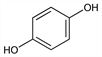
4808. Hydroquinone
Nomenclature
CAS number: 123-31-9
1,4-Benzenediol; p-dihydroxybenzene; hydroquinol; quinol; Aida (Paraphar); Black and White Bleaching Cream (Plough); Eldoquin (Valeant); Eldopaque (Valeant); Tecquinol. C6H6O2; mol wt 110.11.
C 65.45%, H 5.49%, O 29.06%.
Description and references
Prepd by the oxidation of aniline: L. Gattermann, T. Wieland, Die Praxis des Organischen Chemikers (de Gruyter, Berlin, 40th ed., 1961) p 266; by reduction of quinone: Kitchen, US 1322580 (1920); Seyewetz, Miodon, Bull. Soc. Chim. Fr. 33, 449 (1923); by Elbs persulfate oxidation of phenol: Baker, Brown, J. Chem. Soc. 1948, 2303; Forrest, Petrow, ibid. 1950, 2340; from acetylene + CO: Howk, Sauer, US 3055949 (1962 to du Pont). Toxicity data: Woodard et al., Fed. Proc. 8, 348 (1949). Toxicology and carcinogenicity study: F. W. Kari et al., Food Chem. Toxicol. 30, 737 (1992). Review: J. Varagnat in Kirk-Othmer Encyclopedia of Chemical Technology vol. 13 (Wiley-Interscience, New York, 3rd ed., 1981) pp 39-69.
Properties
Crystals, mp 170-171°. d15 1.332. bp 285-287°. Sol in 14 parts water; freely sol in alcohol, ether, slightly in benzene. Its soln becomes brown in the air due to oxidation; the oxidation is very rapid in presence of alkali. Poisonous. Keep well closed and protected from light. Handle with caution. LD50 orally in rats: 320 mg/kg (Woodard).Caution
Harmful effects may occur following overexposure to dust and vapors by inhalation or by contact with skin or eyes. Contact with skin may cause dermatitis. Contact with eyes may cause eye irritation, keratitis, discoloration of conjunctiva and corneal changes. Ingestion may cause tinnitus, nausea, dizziness, sense of suffocation, increased respiration rate, vomiting, pallor, muscle twitching, headache, dyspnea, cyanosis, delirium, and collapse. Urine is usually green or brownish green in color and continues to darken on standing. See Patty's Industrial Hygiene and Toxicology vol. 2B, G. D. Clayton, F. E. Clayton, Eds. (Wiley-Interscience, New York, 4th ed., 1994) pp 1590-1592. See also NIOSH Pocket Guide to Chemical Hazards (DHHS/NIOSH 97-140, 1997) p 170.Use
As photographic reducer and developer; as reagent in the determination of small quantities of phosphate; as antioxidant.Therapeutic Category
Depigmentor.
Keywords
Depigmentor