Nomenclature
CAS number: 78-59-1
3,5,5-Trimethyl-2-cyclohexen-1-one; α-isophorone; 1,5,5-trimethyl-3-oxocyclohexene; 1,3,3-trimethylcyclohexen-5-one; isoforon; isoacetophorone.
C
9H
14O; mol wt 138.21.
C 78.21%, H 10.21%, O 11.58%.
Description and references
Prepn: E. Knoevenagel, Ann. 297, 113 (1897). Synthesis: H. Ueda et al., Agric. Biol. Chem. 30, 1004 (1966); D. S. Torok, W. J. Scott, Tetrahedron Lett. 34, 3067 (1993).
Colorimetric field test for determn in air: P. Andrew, R. Wood, Analyst 95, 691 (1970). Solid-phase
microextraction/GC determn in aq. samples: J.-Y. Horng, S.-D. Huang, J. Chromatogr. A 678, 313 (1994).
Brief description: P. D. Sherman, Jr., A. J. Papa in Kirk-Othmer Encyclopedia of Chemical Technology vol. 13 (Wiley-Interscience, New York, 3rd ed., 1981)
pp 918-922. Review of prepn and purification: G. S. Salvapati, M.
Janardanarao, J. Sci. Ind. Res. 42, 261-267 (1983). Review of toxicology and human exposure:
Toxicological Profile for Isophorone (PB90-180225, 1989) pp 101.
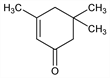
Properties
Clear liquid with peppermint-like odor. bp 215.3°. Freezing pt 8.1°. Flash pt (open cup): 184°F (84°C). Autoignition pt: 864°F (462°C). d2020 0.9229. d420 0.9613. n420 1.4778. uv max
(MeOH): 235.5 nm (ε 14300). Vapor pressure at 20°: 0.3 mm Hg. Soly in water (mg/l): 12000
(20°); 14500 (25°). Sol in ether, acetone alcohol. LD50 in male, female rats and male mice (mg/kg): 2700 ±200, 2100 ±200, 2200 ±200 orally (PB90-180225).Caution
Potential symptoms of overexposure
are irritation of eyes, nose, throat; headache, nausea, dizziness,
fatigue, malaise, narcosis; dermatitis. See NIOSH Pocket Guide to Chemical Hazards (DHHS/NIOSH
97-140, 1997) p 178.Use
Solvent in some printing inks, paints, lacquers
and adhesives.