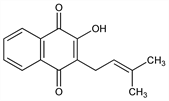
5366. Lapachol
Nomenclature
Description and references
Yellow crystalline material derived from the heartwood of Asian and South American bignoniaceous plants, esp Surinam greenheart, Taigu wood, Lapacho heartwood and Bethabarra wood: Arnoudon, Compt. Rend. 41, 1152 (1857); Stein, J. Prakt. Chem. 99, 1 (1866); Paterno, Gazz. Chim. Ital. 9, 506 (1879); Greene, Hooker, Am. Chem. J. 11, 267 (1889). Structure: Paterno, Gazz. Chim. Ital. 12, 337 (1882); Hooker J. Chem. Soc. 61, 611 (1892); 69, 1355 (1896); J. Am. Chem. Soc. 58, 1168 (1936). Synthesis: Fieser, ibid. 49, 857 (1927); Hooker, ibid. 58, 1181 (1936); G. R. Pettit, L. E. Houghton, J. Chem. Soc. C 1971, 509. Although it is related structurally to vitamin K, q.v., it does not possess antihemorrhagic activity: H. J. Almquist, A. A. Klose, J. Am. Chem. Soc. 61, 1923 (1939); L. F. Fieser et al., J. Biol. Chem. 137, 659 (1941). It is reported to be an inhibitor of respiratory processes: E. G. Ball et al., ibid. 168, 257 (1947). Lapachol has also exhibited antitumor activity vs Walker 256 carcinoma: K. V. Rao et al., Proc. Am. Assoc. Cancer Res. 8, 55 (1967). Mass spectrometry: T. A. Elwood et al., Org. Mass Spectrom. 3, 841 (1970). Chromatographic detection: M. H. Simatupang et al., J. Chromatogr. 52, 180 (1970). Pharmacology: S. M. Sieber et al., Cancer Treat. Rep. 60, 1127 (1976). Toxicity study: R. K. Morrison et al., Toxicol. Appl. Pharmacol. 17, 1 (1970). Review of antitumor activity: K. V. Rao, Cancer Chemother. Rep. Part 2 4 (4), 11-17 (1974).