5501. Lindane
Nomenclature
Description and references
Active isomer among the eight well-described stereoisomers of hexachlorocyclohexane. Prepn: T. Hardie, US 2218148 (1940 to ICI); R. E. Slade, Chem. Ind. (London) 1945, 314; F. A. Gunther, ibid. 1946, 399. Metabolism: R. Engst et al., Residue Rev. 68, 59 (1977); 72, 71 (1979). Acute toxicity: T. B. Gaines, Toxicol. Appl. Pharmacol. 14, 515 (1969). Review of isomers: I. Hornstein, Science 121, 206 (1955); S. H. Safe in Kirk-Othmer Encyclopedia of Chemical Technology vol. 6 (John Wiley & Sons, New York, 4th ed., 1993) pp 135-139. Reviews of carcinogenic risk: M. D. Reuber, Environ. Res. 19, 460-481 (1979); S. D. Vesselinovitch, F. W. Carlborg, Toxicol. Pathol. 11, 12 (1983); of toxicology and human exposure: Toxicological Profile for Alpha, Beta, Gamma, and Delta-Hexachlorocyclohexane (PB2006-100003, 2005) 377 pp.
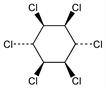
Properties
Crystals, mp 112.5°. Slight musty odor. Vapor pressure at 20°: 9.4 × 106 mm Hg. nD20 1.644. Soly in g/100 g at 20°: acetone 43.5, benzene 28.9, CHCl3 24.0, ether 20.8, ethanol 6.4. Insol in water. LD50 in male, female rats (mg/kg): 88, 91 orally (Gaines).Caution
Poisoning may occur by ingestion, inhalation, or percutaneous absorption. Potential symptoms of overexposure are irritation of eyes, skin, nose, throat; dizziness, headache, nausea, vomiting, diarrhea, tremors, weakness, convulsions, dyspnea, cyanosis; aplastic anemia; muscle spasms. See NIOSH Pocket Guide to Chemical Hazards (DHHS/NIOSH 97-140, 1997) p 186; Clinical Toxicology of Commercial Products, R. E. Gosselin et al., Eds. (Williams & Wilkins, Baltimore, 5th ed., 1984) Section III, pp 239-241. Lindane and other hexachlorocyclohexane isomers are reasonably anticipated to be human carcinogens: Report on Carcinogens, Eleventh Edition (PB2005-104914, 2004) p III-162.Use
Insecticide.Therapeutic Category
Pediculicide; scabicide.
Therapeutic Category (Veterinary)
Ectoparasiticide.Keywords
Ectoparasiticide