5908. Mesityl Oxide

Nomenclature

CAS number: 141-79-7
4-Methyl-3-penten-2-one; 2,2-dimethylvinyl methyl ketone; isopropylideneacetone; 2-methyl-4-oxo-2-pentene.
C6H10O; mol wt 98.14.
C 73.43%, H 10.27%, O 16.30%.

Description and references

Made by distilling diacetone alcohol with a small amount of iodine: Conant, Tuttle, Org. Synth. 1, 53 (1921). Condensation of acetone to mesityl oxide using sulfonated polystyrene-divinylbenzene resin as ion exchange catalyst: Klein, Banchero, Ind. Eng. Chem. 48, 1278 (1956). Believed to be a mixture of two isomers. Toxicity data: N. F. Izmerov et al., Toxicometric Parameters of Industrial Toxic Chemicals Under Single Exposure (Centre Internat. Projects, Moscow, 1982) p 81. Brief review of toxicity: Dangerous Prop. Ind. Mater. Rep. 9, 58-65 (1989).
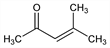
Chemical structure

Properties

Colorless, oily liq; honey-like odor. d415 0.8592. bp760 130°; bp100 72.1°; bp20 26°; bp1.0 8.7°. mp 41.5°; also reported as mp 59°. Can be made to crystallize at low temp in petr ether. nD22 1.4425. Absorption spectrum: Morton, J. Chem. Soc. 1926, 719. Sol in about 30 parts water; miscible with most organic liqs. Flash pt: 87°F (30.6°C). LD50 in mice (mg/kg): 710 ±85 intragastric; LC50 in mice (2 hr), rats (4 hr) (mg/m3): 10000 ±270, 9000 ±600 (Ismerov).

Caution

Potential symptoms of overexposure are irritation of eyes, skin and mucous membranes; narcosis, coma. See NIOSH Pocket Guide to Chemical Hazards (DHHS/NIOSH 97-140, 1997) p 194.

Use

Solvent for nitrocellulose, many gums and resins, particularly vinyl resins. In lacquers, varnishes and enamels. In making methyl isobutyl ketone.