6310. Muscarine
Nomenclature
Description and references
Alkaloid from the red variety of Amanita muscaria (L.) Pers., Agaricaceae, the fly fungus, a poisonous mushroom. Also found in some other fungi: Inocybe patouillardi; I. fastigiata, I. umbrina; I. rimosa. Isoln procedure for the naturally occurring l-(+)-form: Kuehl et al., J. Am. Chem. Soc. 77, 6663 (1955); Eugster, Helv. Chim. Acta 39, 1002 (1956). Structure and synthesis of racemate: K"ogl et al., Rec. Trav. Chim. 76, 109 (1957); K"ogl et al., Experientia 13, 137, 138 (1957); Cox et al., Helv. Chim. Acta 41, 229 (1958). Alternate syntheses: GB 828395 (1960 to Hoffmann-La Roche); Matsumoto et al., Tetrahedron 25, 5889 (1969); W. C. Still, J. A. Schneider, J. Org. Chem. 45, 3375 (1980). Synthesis of muscarine: Whiting et al., Can. J. Chem. 50, 3322 (1972); A. M. Mubarak, D. M. Brown, Tetrahedron Lett. 21, 2453 (1980); eidem, J. Chem. Soc. Perkin Trans. 1 1982, 809; S. Pochet, T. Huynhdinh, J. Org. Chem. 47, 193 (1982). Chemistry and pharmacology: Waser, Pharmacol. Rev. 13, 465-515 (1961). Toxicity study: P. J. Fraser, Br. J. Pharmacol. 12, 47 (1957). Reviews: C. H. Eugster, Adv. Org. Chem. 2, 427-455 (1960); S. Wilkinson, Q. Rev. Chem. Soc. 15, 153-171 (1961). Configurational relationship in the muscarine series: Bollinger, Eugster, Helv. Chim. Acta 54, 2704 (1971).
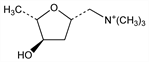
Derivative
Chloride.Properties
Stout prisms from ethanol + acetone, mp 180-181°. Extremely hygroscopic. [α]D25 +8.1° (c = 3.5 in ethanol). Very sol in water, ethanol. Slightly sol in chloroform, ether, acetone. Aq solns are stable. LD50 i.v. in mice: 0.23 mg/kg (Fraser).Caution
Potential symptoms of toxicity following ingestion are profuse sweating, increased salivation, visual disturbances, nausea, vomiting, abdominal colic, diarrhea, headache, and bronchospasm. Very high doses may produce lacrimation, incontinence, bradycardia, hypotension and shock. See Clinical Toxicology of Commercial Products, R. E. Gosselin et al., Eds. (Williams & Wilkins, Baltimore, 5th ed., 1984) Section II, p 247.Therapeutic Category
Cholinergic.
Keywords
Cholinergic