6759. Octopamine
Nomenclature
Description and references
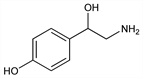
A biogenic amine that is the phenol analog of noradrenaline (norepinephrine, q.v.). It is a neurosecretory product found in several vertebrates and invertebrates. Formed by β-hydroxylation of tyramine by the enzyme dopamine β-hydroxylase: Pisano et al., Biochim. Biophys. Acta 43, 566 (1960). Identification: Erspamer, Nature 169, 375 (1952). Found in the salivary glands of Octopus vulgaris, O. macropus, and of Eledone moschata: idem, Arzneim.-Forsch. 2, 253 (1952); in mammalian nerves: Molinoff, Axelrod, Science 164, 428 (1969); in cockroach nervous system: Nathanson, Greengard, ibid. 180, 308 (1973). Prepd synthetically: Asscher, US 2585988 (1952). The natural d(-) form is 3 times more potent than the l(+) form in producing cardiovascular adrenergic responses in anesthetized dogs and cats: Korol, Soffer, Pharmacologist 5, 247 (1963). Prepn of d- and l-forms: Kappe, Armstrong, J. Med. Chem. 7, 569 (1964). In invertebrate nervous systems octopamine may function as a neurotransmitter: Saavedra et al., Science 185, 364 (1974). Effects on neuromuscular transmission in crustacean muscle: C. A. Breen, H. L. Atwood, Nature 303, 716 (1983).
Derivative
d(-)-Form.Nomenclature
Properties
Crystals from hot water which change at about 160° to a compd which melts above 250° (dec). [α]D25 -56.0° (0.1N HCl); -37.4° (H2O).Derivative
dl-Form hydrochloride.Nomenclature
Properties
Crystals, dec 170°. Freely sol in water.Therapeutic Category
Adrenergic.
Keywords
α-Adrenergic Agonist