6982. Paclitaxel
Nomenclature
Description and references
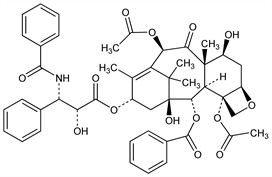
Antiproliferative agent first isolated, as the l-form, from the bark of the Pacific yew tree, Taxus brevifolia, Taxaceae; promotes the assembly of microtubules and inhibits the tubulin disassembly process. Isoln and structure: M. C. Wani et al., J. Am. Chem. Soc. 93, 2325 (1971). In vitro promotion of microtubule assembly: P. B. Schiff et al., Nature 277, 665 (1979). Isoln from Taxus baccala L. and in vitro inhibition of depolymerization of microtubules into tubulin: G. Chauviere et al., C. R. Seances Acad. Sci. Ser. 2 293, 501 (1981). Total synthesis of taxusin, which contains the entire ring skeleton: R. A. Holton et al., J. Am. Chem. Soc. 110, 6558 (1988). Total stereosynthesis: R. A. Holton et al., ibid. 116, 1597, 1599 (1994); K. C. Nicolaou et al., Nature 367, 630 (1994). Production by Taxomyces andreanae, an endophytic fungus associated with T. brevifolia: A. Stierle et al., Science 260, 214 (1993). Review of mechanism of action: J. J. Manfredi, S. B. Horwitz, Pharmacol. Ther. 25, 83-125 (1984); S. B. Horwitz et al., Ann. N.Y. Acad. Sci. 466, 733-744 (1986); S. B. Horwitz, Trends Pharmacol. Sci. 13, 134-136 (1992). Symposium on clinical toxicology, pharmacology and efficacy: Semin. Oncol. 20, Suppl. 3, 1-60 (1993). Review of clinical experience in cancer therapy: T. M. Mekhail, M. Markman, Expert Opin. Pharmacother. 3, 755-766 (2002). Clinical trial in prevention of coronary artery restenosis: G. W. Stone et al., N. Engl. J. Med. 350, 221 (2004).
Properties
Needles from aq methanol, mp 213-216° (dec). [α]D20 -49° (methanol). uv max (methanol): 227, 273 nm (ε 29800, 1700).Use
Tool in study of structure and function of microtubules.Therapeutic Category
Antineoplastic; antirestenotic.
Keywords
Antineoplastic; Alkaloids/Natural Products; Taxanes; Antirestenotic