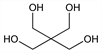
7111. Pentaerythritol
Nomenclature
CAS number: 115-77-5
2,2-Bis(hydroxymethyl)-1,3-propanediol; tetrakis(hydroxymethyl)methane; tetramethylolmethane; Metab-Auxil; Penetek; Pentek. C5H12O4; mol wt 136.15.
C 44.11%, H 8.88%, O 47.01%.
Description and references
Prepd by treating acetaldehyde with formaldehyde in an aq soln of calcium hydroxide: H. B. J. Schurink, Org. Synth. coll. vol. I, 425 (2nd ed., 1941); Fieser, Fieser, Organic Chemistry (2nd ed, 1950) p 133. Review of mfg processes: P. W. Sherwood, Petroleum Refiner Nov. 1956, p 171-179; Faith, Keyes & Clark's Industrial Chemicals, F. A. Lowenheim, M. K. Moran, Eds. (Wiley-Interscience, New York, 4th ed., 1975) pp 598-603. Monograph: E. Berlow et al., The Pentaerythritols, ACS Monograph Series no. 136 (Reinhold, New York, 1958).
Properties
Ditetragonal crystals from dil HCl, mp 260°. One gram dissolves in 18 ml water at 15°. Sol in ethanol, glycerol, ethylene glycol, formamide. Insol in acetone, benzene, paraffin, ether, carbon tetrachloride.Derivative
Tetraacetate.Nomenclature
CAS number: 597-71-7
2,2-Bis[(acetyloxy)methyl]-1,3-propanediol diacetate; tetra-O-acetylpentaerythritol; pentaerythrityl tetraacetate. C13H20O8; mol wt 304.29.
C 51.31%, H 6.62%, O 42.06%.
Description and references
Prepn: Wolfrom et al., J. Am. Chem. Soc. 73, 874 (1951); Bonner et al., J. Chem. Soc. 1960, 2914.