Nomenclature
CAS number: 578-94-9
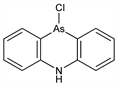
10-Chloro-5,10-dihydrophenarsazine; 5-aza-10-arsenaanthracene chloride; 10-chloro-5,10-dihydroarsacridine; diphenylaminechlorarsine; phenazarsine chloride; adamsite; DM.
C
12H
9AsClN; mol wt 277.58.
C 51.92%, H 3.27%, As 26.99%, Cl 12.77%, N 5.05%.
Description and references
Prepd by heating diphenylamine with arsenic
trichloride: DE 281049 (1914 to I. G. Farben.); Wieland, Reinheimer, Ann. 423, 12 (1921); Lewis, Hamilton, J. Am. Chem. Soc. 43, 2222 (1921);
Burton, Gibson, J. Chem. Soc. 1926, 450.
Properties
Canary-yellow crystals from carbon tetrachloride.
Poisonous. Dimorphous. The stable
form occurs as orthorhombic crystals; d 1.65; mp 195°; bp 410° (decompn). Sublimes readily. Vapor press. at 20° = 2 × 10-13 mm; volatility 0.02 mg/cu m; heat of volatilization 54.8
cal; spec heat 0.268 cal. Practically insol in water. Slightly sol
in benzene, xylene, carbon tetrachloride. Corrodes iron, bronze,
brass. (The metastable form melts at 186° if monoclinic, and at 182°
if triclinic.)Caution
Irritating to skin and respiratory
tract. Causes profuse watery nasal discharge; severe pain in nose,
sinuses, chest; sneezing, coughing, nausea, vomiting, marked depression,
weakness. Sensory disturbances may occur later.Use
As war gas, dispersed in air in the form of minute
particles. For riots in combination with tear gas (chloroacetophenone).
In the formulation of wood-treating solns, against marine borers
and similar pests.