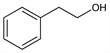
7224. Phenethyl Alcohol
Nomenclature
Description and references
Found in a number of natural essential oils, such as rose, carnation, hyacinth, Aleppo pine, orange blossom, geranium Bourbon, neroli and in the essential oil of champaca. Prepd by reduction of ethyl phenylacetate with sodium in abs alcohol: Bouveault, Blanc, Bull. Soc. Chim. [3] 31, 672 (1904); Leonard, J. Am. Chem. Soc. 47, 1778 (1925); by hydrogenation of phenylacetaldehyde in the presence of nickel catalyst: Skita, Ritter, Ber. 43, 3398 (1910); v. Braun, Kochend"orfer, Ber. 56, 2176 (1923); Milligan, Reid, J. Am. Chem. Soc. 44, 204 (1922). Isoln from the fungus Gibberella fujikuroi: Cross et al., J. Chem. Soc. 1963, 2937. Antibacterial activity: R. M. E. Richards et al., J. Pharm. Pharmacol. 21, 681 (1969). Use as preservative in ophthalmic solutions: R. M. E. Richards, R. J. McBride, ibid. 24, 145 (1972). Toxicity: Jenner et al., Food Cosmet. Toxicol. 2, 327 (1964).