Nomenclature
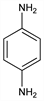
CAS number: 106-50-3
1,4-Benzenediamine;
p-diaminobenzene;
p-aminoaniline; orsin; C.I. 76076; Ursol D.
C
6H
8N
2; mol wt 108.14.
C 66.64%, H 7.46%, N 25.90%.
Description and references
Prepn: A. Rinne, T. Zincke, Ber. 7, 869 (1874); DE 202170 (1907 to BASF), C.A. 3, 382 (1909);
A. J. Quick, J. Am. Chem. Soc. 42, 1033 (1920); J. F. Norris, E. O. Cummings, Beilstein 17, 305 (1925). See also: Beilstein XIII, 61 (1930). Crystal structure: A. Domenicano et
al., Acta Crystallogr. B33, 1664 (1977). Mutagenicity studies: B. N. Ames et
al., Proc. Natl. Acad. Sci. USA 72, 2423 (1975); W. G. H. Blijleven, Mutat. Res. 48, 181 (1977). Toxicity study:
C. Burnett et al., J. Toxicol.
Environ. Health 2, 657 (1977).
Properties
White to slightly red crystals; darkens on exposure
to air. mp 145-147°. bp 267°. Sol
in 100 parts cold water; sol in alcohol, chloroform, ether. A black
color is developed with 3% H2O2; brown with
5% FeCl3 soln. Keep well closed
and protected from light. LD50 in rats (mg/kg): 80 orally, 37 i.p. (Burnett).Derivative
Hydrochloride.
Properties
White to slightly reddish crystals. Freely sol
in water, slightly in alcohol, ether.Caution
Potential symptoms of overexposure
are irritation of pharynx and larynx; bronchial asthma; sensitization
dermatitis. See NIOSH Pocket Guide
to Chemical Hazards (DHHS/NIOSH 97-140, 1997) p 248.Use
Dyeing furs; also in photochemical measurements,
accelerating vulcanization; manuf azo dyes, etc. The hydrochloride
as reagent for blood, H
2S, amyl alcohol; in testing of
milk.