Description and references
Fiber forming polyesters prepd from terephthalic acid, q.v. or its esters
and ethylene glycol: Whinfield, Dickson, US 2465319 (1949 to du Pont). Review
of structures, definition of trade names: R. W. Moncrieff, Man-Made Fibres (John Wiley & Sons, New
York, 4th ed., 1963) pp 361-389, 707-723.
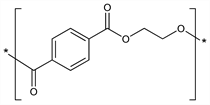
Properties
R = OH, Dacron, Amilar, Fiber V. Solid, dec at approx 250°. Sp gr 1.38. Sol in hot m-cresol, trifluoroacetic acid, o-chlorophenol,
a mixture of 7 parts of trichlorophenol and 10 parts (by wt) of phenol,
a mixture of 2 parts of tetrachloroethane and 3 parts (by wt) of phenol.
Fiber has good resistance to weak acids even at boiling temp, to
strong acids in the cold, to weak alkalies, to bleaches, to most alcohols,
ketones, soaps, detergents, and dry cleaning agents. Fabric has good
resistance to creasing, abrasion, heat aging, and sunlight when behind
glass. When “heat-set”, fabric will not shrink in either boiling
water or boiling drycleaning solvent. Fabric burns, but local melting
generally prevents spread of fire. Insects cannot thrive on the fiber,
but some can cut through it. Molds, mildew, and fungi may grow on
applied finishes, but do not attack fiber. R = OCH3, Terylene. For physical properties, see Dacron above.
Other similar products: Diolen, Enkalene, Fortrel, Tergal, Terital, Terlenka, Trevira, Mylar.Use
In fabric manufacture; as films; as base for magnetic
coatings. Surgical aid (arterial grafts).