7918. Pseudomonic Acids
Description and references
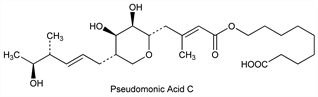
A group of antibacterial antibiotics produced by Pseudomonas fluorescens NCIB 10586 that have unusual structural features. Four members of the group are known: pseudomonic acid A, the major component; pseudomonic acid B, the 3,4,5-trihydroxy analog of A (also referred to as pseudomonic acid I); pseudomonic acid D, the 4-nonenoic acid analog of A; and pseudomonic acid C, in which the epoxide oxygen is replaced by a double bond. Isoln and characterization of A and B: A. T. Fuller et al., Nature 234, 416 (1971); K. D. Barrow, G. Mellows, DE 2227739; eidem, US 3977943 (1973, 1976 both to Beecham). Structure of B: E. B. Chain, G. Mellows, J. Chem. Soc. Perkin Trans. 1 1977, 318. Prepn of C: N. H. Rogers, P. J. O'Hanlon, EP 3069; eidem, US 4205002 (1979, 1980 both to Beecham). Isoln, structure, configuration of C: J. P. Clayton et al., Tetrahedron Lett. 21, 881 (1980). Total syntheses of naturally occurring (+)-form of C: A. P. Kozikowski et al., J. Am. Chem. Soc. 102, 6577 (1980); in high yield: C. Mckay et al., Chem. Commun. 2000, 1109; of racemic A or C: B. B. Snider, G. B. Phillips, J. Am. Chem. Soc. 104, 1113 (1982); B. B. Snider et al., J. Org. Chem. 48, 3003 (1983). Prepn of D: P. J. O′Hanlon, EP 68680 (1983 to Beecham), C.A. 98, 159135t (1983); P. J. O′Hanlon et al., J. Chem. Soc. Perkin Trans. 1 1983, 2655. Antimycoplasmal activity in vitro: R. M. Banks et al., J. Antibiot. 41, 609 (1988).