7964. Pyrethrins
Description and references
Active insecticidal constituents of pyrethrum flowers. Isoln: Staudinger, Ruzicka, Helv. Chim. Acta 7, 177 (1924). Prepn by reconstitution from pyrethrolone and chrysanthemic acid: Elliott, Janes, Chem. Ind. (London) 1969, 270. Structure: Crombie et al., J. Chem. Soc. 1956, 3963; Godin et al., J. Chem. Soc. C 1966, 332. Stereochemistry: Begley et al., Chem. Commun. 1972, 1276. Biosynthesis: Crowley et al., Biochim. Biophys. Acta 60, 312 (1962). Review: Crombie, Elliott, Fortschr. Chem. Org. Naturst. 19, 120 (1961). Review of toxicology and human exposure: Toxicological Profile for Pyrethrins and Pyrethroids (PB2004-100004, 2003) 332 pp.
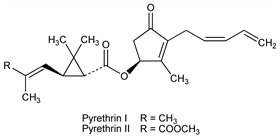
Derivative
Pyrethrin I.Nomenclature
CAS number: 121-21-1
(1R,3R)-2,2-Dimethyl-3-(2-methyl-1-propenyl)cyclopropanecarboxylic
acid (1S)-2-methyl-4-oxo-3-(2Z)-2,4-pentadienyl-2-cyclopenten-1-yl
ester; chrysanthemummonocarboxylic acid pyrethrolone ester. C21H28O3; mol wt 328.45.
C 76.79%, H 8.59%, O 14.61%.
Properties
Viscous liquid. bp0.0005 146-150°. nD20 1.5242. [α]D20 -14° (isooctane). uv max (95% ethanol): 225 nm (ε 36400). Oxidizes readily and becomes inactive in air. Should be refrigerated and stored in darkness. Stability data of pyrethrins I and II: Godin, Pyrethrum Post 9, 17 (1968), C.A. 71, 12031q (1969). Practically insol in water. Sol in alcohol, petr ether, kerosene, carbon tetrachloride, ethylene dichloride, nitromethane.Derivative
Pyrethrin II.Nomenclature
CAS number: 121-29-9
(1R,3R)-3-[(1E)-3-Methoxy-2-methyl-3-oxo-1-propenyl]-2,2-dimethylcyclopropanecarboxylic
acid (1S)-2-methyl-4-oxo-3-(2Z)-2,4-pentadienyl-2-cyclopenten-1-yl
ester; chrysanthemumdicarboxylic acid monomethyl ester pyrethrolone
ester. C22H28O5; mol wt 372.45.
C 70.95%, H 7.58%, O 21.48%.