8123. Razoxane
Nomenclature
Description and references
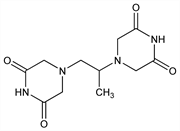
Cyclized analog of EDTA, q.v.; exhibits intracellular iron chelating activity. Plays role in preventing the formation of doxorubicin-iron complexes which generate radical oxygen species that are associated with cardiotoxicity. Prepn: A. M. Creighton et al., Nature 222, 384 (1969); idem, GB 1234935; idem, US 3941790 (1971, 1976 both to Natl. Res. Dev. Corp.). Mode of action: H. B. A. Sharpe et al., Nature 226, 524 (1970). Metabolism: R. E. Bellet et al., Eur. J. Cancer 13, 1293 (1977). Pharmacology: A. Atherton, ibid. 11, 383 (1975). Clinical studies: M. T. Bakowski et al., Int. J. Radiat. Oncol. Biol. Phys. 4, 115 (1978); H. W. Bruckner et al., Cancer Treat. Rep. 66, 1713 (1982). Toxicity study: E. Hassenstein, K. Renner, Strahlentherapie 154, 122 (1978). Clinical evaluation in renal cell cancer: J. P. Braybrooke et al., Clin. Cancer Res. 6, 4697 (2000). Review of antineoplastic activity and radiosensitization: M. T. Bakowski, Cancer Treat. Rev. 3, 95-107 (1976); K. Hellmann, W. Rhomberg, ibid. 18, 225-240 (1991).
Properties
Pale cream microcrystalline solid, mp 237-239°.Derivative
(+)-Form.Nomenclature
Description and references
Clinical pharmacokinetics: R. H. Earhart et al., Cancer Res. 42, 5255 (1982). HPLC determn in plasma and urine: R. C. Lewis et al., Pharm. Res. 9, 101 (1992). Clinical study of protection vs doxorubicin-associated cardiomyopathy: J. L. Speyer et al., J. Clin. Oncol. 10, 117 (1992); S. E. Lipshultz et al., N. Engl. J. Med. 351, 145 (2004). Review of pharmacology and clinical studies: J. Koning et al., Cancer Treat. Rev. 18, 1-19 (1991); of therapeutic role as a cardioprotectant: S. M. Swain, P. Vici, J. Cancer Res. Clin. Oncol. 130, 1-7 (2004); of development and clinical experience: S. W. Langer, Expert Rev. Anticancer Ther. 7, 1081-1088 (2007).
Properties
Crystals from aq methanol/ether, mp 193°. [α]D +11.35° (c = 5 in DMF). Soly (mg/ml): 10-12 water, 35-43 0.1N HCl, 25-34 0.1N NaOH, 6.7-10 10% ethanol, 1 methanol, 7.1-10 H2O/DMA (1:1), 9.7-14.5 0.1M citrate buffer (pH 4), 8.7-13 0.1M borate buffer (pH 9). pKa 2.1. Partition coefficient (octanol/water): 0.025. Degrades rapidly above pH 7.0.Derivative
(+)-Form hydrochloride.Nomenclature
Description and references
Clinical experience of cardioprotective effect in anthracycline treated breast cancer: M. Marty et al., Ann. Oncol. 17, 614 (2006).
Therapeutic Category
Racemate as antineoplastic. (+)-Form as cardioprotectant.
Keywords
Antineoplastic; Topoisomerase II Inhibitor
Dexrazoxane: Cardioprotective