8277. Royal Jelly
Nomenclature
Queen bee jelly; apilak; Weiselfuttersaft (German); Gelée royale (French).Description and references
Secretion from the salivary glands of the worker honey bee which is essential for the development of queen bees. See also Queen Substance. Production from bee hives: Ritschel, Oesterr. Drogisten-Ztg. 12, 4-7 (1958). Synthetic mixture fed to bee larvae maintains life, but does not produce queens. The presence of hormones affecting mammals has not been demonstrated: Hinglais, Gautherie, Compt. Rend. 242, 2483 (1956). No practical utility in human nutrition because of the very large amounts required for any definite effect: Moreaux, Bull. Soc. Sci. Nancy 14, 49-53 (1955), C.A. 50, 13214f (1956). Review of composition and biological activity: A. D. Dayan, J. Pharm. Pharmacol. 12, 377-383 (1960). Monographs: B. deBelvefer, Royal Jelly (Paris, Librairie Maloine, 1958) 270 pp; H. Rembold, Biologically Active Substances in Royal Jelly in Vitam. Horm. 23, 359-382 (1965).
Properties
Milky white, highly viscous secretion. Analysis of fresh specimen (% wt at pH 5): moisture 65-70, protein 15-20, carbohydrate 10-15, lipid 1.7-6, ash 0.7-2.0; elemental analysis: P up to 0.5, S up to 0.6; trace elements present: Na, K, Fe, Cu, Mg, Mn, Ca. Vitamins (μg/g): thiamine 2, riboflavine 10, pyridoxine 2, nicotinic acid 75, biotin 2, folic acid 0.3, inositol 100, pantothenic acid 250, ascorbic acid 3-5, vitamin D trace, vitamin E trace. When stored at room temp, changes to a lightly yellow gum, and after some weeks, to a brittle amber solid.Derivative
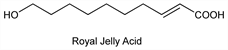
Royal jelly acid.Nomenclature
trans-10-Hydroxy-Δ2-decenoic acid.Description and references
Constitutes ≈10% of the dried royal jelly. Isoln: Townsend, Lucas, Biochem. J. 34, 1155 (1940); Butenandt, Rembold, Z. Physiol. Chem. 308, 284 (1957). Synthesis: Fray et al., Tetrahedron Lett. 4, 15 (1960); Smissman et al., J. Org. Chem. 29, 3517 (1964); Bestmann et al., Ann. 699, 33 (1966); J. Tsuji et al., Bull. Chem. Soc. Jpn. 50, 2507 (1977); T. Fujisawa et al., Chem. Lett. 1982, 219; R. Chiron, J. Chem. Ecol. 8, 709 (1982). Leukemia prevention in mice: Townsend et al., Nature 183, 1270 (1959).