8278. Rubber
Nomenclature
Caoutchouc; India rubber.Description and references
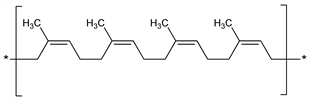
Primarily obtained by coagulating the milk juice (latex) of several tropical trees, chiefly Hevea brasiliensis Muell.-Arg., Euphorbiaceae. Habit. Brazil, East Indies, Java, etc. Rubber also occurs in a number of plants, among which guayule (Parthenium argentatum Gray), a shrub which grows primarily in the northern Mexican desert, represents a potentially useful renewable source. Guayule produces rubber which is chemically identical to Hevea rubber in amounts ranging from 10-20% (dry basis) distributed in the roots and stems. See E. Campos-Lopez, J. Polym. Sci. Polym. Lett. Ed. 14, 649 (1976); J. Polym. Sci. Polym. Chem. Ed. 14, 1561 (1976); J. D. Johnson, C. W. Hinman, Science 208, 460 (1980). Possible biosynthesis from acetate through mevalonic acid and isopentenyl pyrophosphate: Archer et al., Nature 184, 268 (1959). Comprehensive review of chemistry: Ellis, Chem. Ind. (London) 1962, 1447. Book: L. G. Polhamus, Rubber (Wiley, New York, 1962). Review: Jirgenson's, Natural Organic Macromolecules (Pergamon Press, New York, 1962) pp 115-124; D. R. St. Cyr in Kirk-Othmer Encyclopedia of Chemical Technology vol. 20 (Wiley-Interscience, New York, 3rd ed., 1982) pp 468-491. Natural rubber is defined as a cis-1,4-polyisoprene with a molecular weight varying from 100,000 to one million.