8725. Sorbitol
Nomenclature
Description and references
First found in the ripe berries of the mountain ash Pyrus aucuparia Ehrh. (L.) (Sorbus aucuparia L.), Rosaceae. Occurs also in many other berries (except grapes) and in cherries, plums, pears, apples, seaweed and algae. Has been detected in blackstrap molasses. Isoln from berries: Embden, Griesbach, Z. Physiol. Chem. 91, 268 (1914). Prepd industrially from glucose by high pressure hydrogenation or by electrolytic reduction: Boye, Chem. Ztg. 82, 657 (1958); Fedor et al., Ind. Eng. Chem. 52, 282 (1960); from dextrose by catalytic hydrogenation: Faith, Keyes & Clark's Industrial Chemicals, F. A. Lowenheim, M. K. Moran, Eds. (Wiley-Interscience, New York, 4th ed., 1975) pp 774-778. Review of uses: Kempf, Staerke 6, 269-274 and 303-306 (1954); 9, 234-237 (1955).
Properties
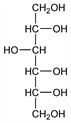
Needles with or 1H2O. Sweet taste, ≈60% as sweet as sugar (w/w). In the healthy human organism 1.0 g of sorbitol yields 3.994 calories which is comparable to 3.940 calories from 1.0 g of cane sugar. Seventy percent of orally ingested sorbitol is converted to CO2 without appearing as glucose in the blood: Adcock, Gray, Biochem. J. 65, 554 (1957). The hydrated crystals melt somewhat below 100°. When completely anhydr mp 110-112°. [α]D20 2.0° (H2O). In the presence of molybdate the rotation is reversed and increased to +56°. Freely sol in water (up to 83%). High % sorbitol solns are much more viscous than corresp glycerol solns. Quite sol in hot alcohol, sparingly sol in cold alcohol. Also sol in methanol, isopropanol, butanol, cyclohexanol, phenol, acetone, acetic acid, DMF, pyridine, acetamide solns. Practically insol in most other organic solvents. Not attacked in the cold when mixed with dil acids, alkalies or mild oxidizing substances. pKa (17.5°): 13.6. pH about 7.0. A commercial 70% aq soln may have the following characteristics: d2020 1.2879; nD25 1.45831; [α]D20 2.10°; bp760 105°; pH between 6 and 7; viscosity (25°): 110 cP. d420 for various % solns: 5% 1.014; 10% 1.038; 25% 1.099; 50% 1.198; 60% 1.249; 70% 1.299; 83% 1.391. Viscosity in cP at 20°: 5% soln 1.230; 10% 1.429; 25% 2.689; 50% 11.09; 60% 35.73; 70% 185; 83% >10,000.Use
In manuf of sorbose, ascorbic acid, propylene glycol, synthetic plasticizers and resins; as humectant (moisture conditioner) on printing rolls, in leather, tobacco. In writing inks to insure a smooth flow and to prevent crusting on the point of the pen. In antifreeze mixtures with glycerol or glycols. In candy manuf to increase shelf life by retarding the solidification of sugar; as humectant and softener in shredded coconut and peanut butter; as texturizer in foods; as sequestrant in soft drinks and wines. Used to reduce the undesirable aftertaste of saccharin in foodstuffs; as sugar substitute for diabetics. Pharmaceutic aid (flavor; tablet excipient); to increase absorption of vitamins and other nutrients in pharmaceutical preparations: Chem. Eng. News 36, 59 (Feb. 24, 1958).Therapeutic Category
Laxative.
Therapeutic Category (Veterinary)
In ruminant ketosis, osmotic diuretic, laxative.Keywords
Laxative/Cathartic