9188. Tetracaine Hydrochloride
Nomenclature
CAS number: 136-47-0
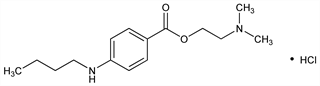
4-(Butylamino)benzoic acid 2-(dimethylamino)ethyl ester monohydrochloride; p-butylaminobenzoyl-2-dimethylaminoethanol hydrochloride; 2-dimethylaminoethyl 4-n-butylaminobenzoate hydrochloride; dicain; amethocaine hydrochloride; Anethaine (Glaxo); Decicain (Winthrop); Pantocaine (Hoechst); Pontocaine Hydrochloride (Sanofi Winthrop); Tonexol (Pharmaton). C15H25ClN2O2; mol wt 300.82.
C 59.89%, H 8.38%, Cl 11.79%, N 9.31%, O 10.64%.
Description and references
Prepn: US 1889645 (1932); GB 815144 (1959 to Abbott). Prepn of pharmaceutical dosage forms: Shupe, US 3272700 (1966 to Sterling Drug). Mechanism of action studies: Y.-W. Leung et al., J. Infect. Dis. 136, 679 (1977). Toxicity study: Dawes, Br. J. Pharmacol. Chemother. 1, 90 (1946). Acute toxicity: B. A. Bopp et al., J. Pharm. Sci. 67, 882 (1978). Comprehensive description: M. Riaz, Anal. Profiles Drug Subs. 18, 379-411 (1989).
Properties
Faintly bitter crystals producing transient numbness of the tongue. mp 147-150°. pKa 8.39. uv max (water): 225, 310 nm (ε 14108, 26352); (0.1N H2SO4): 229, 281, 312 nm (E1%1cm 509, 55, 76); (methanol): 226, 310 nm (ε 7586, 29512); (chloroform): 308 nm (ε 27542). Sol at 20° in 7.5 parts water, 40 parts alcohol; 30 parts chloroform. Practically insol in ether, benzene, acetone. The aq soln is neutral to litmus. Aq solns are stable and may be sterilized by brief boiling. LD50 i.p. in mice: 70 mg/kg (Dawes); also reported as LD50 in female mice (mg/kg): 13 i.v.; 35 s.c. (Bopp).Therapeutic Category
Anesthetic (local).
Therapeutic Category (Veterinary)
Anesthetic (topical).Keywords
Anesthetic (Local)