Nomenclature
CAS number: 78-00-2
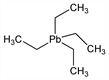
Tetraethylplumbane; lead tetraethyl; TEL.
C
8H
20Pb; mol wt 323.44.
C 29.71%, H 6.23%, Pb 64.06%.
Description and references
Prepd by the action of PbCl2 on
zinc ethyl or on a Grignard reagent; by heating C2H5Cl and sodium-lead alloy in an autoclave. Production from
lead, ethylene, and hydrogen using triethylaluminum as intermediate
was first described by K. Ziegler at the 14th International Congress
of Pure and Applied Chemistry (July 1955): Chem. Eng. News 33, 3486 (1955). Alternate synthesis using nonhalide compds: Pearson et al. in Adv. Chem. Ser. 23, entitled “Metal-Organic Compounds,” M. Sittig, Ed.
(ACS, Washington DC, 1959) pp 299-305. See also Milde,
Beatty, ibid., 306-318. Toxicity study: Schroeder et al., Experientia 28, 923 (1972). Review
of toxicology and human exposure: Toxicological
Profile for Lead (PB99-166704, 1999) 640 pp.
Properties
Colorless liq; burns with an orange-colored flame
with green margin. Extremely poisonous. d20 1.653. bp ≈200° also stated
as 227.7° with decompn. nD20 1.5198. Practically insol in water. Sol in benzene,
petr ether, gasoline, slightly in alcohol. LD50 orally in rats: 12.3 mg/kg (Schroeder).Caution
Potential symptoms of overexposure
are insomnia, lassitude and anxiety; tremor, hyper-reflexia and spasticity;
bradycardia, hypotension, hypothermia, pallor, nausea, anorexia and
weight loss; confusion, disorientation, hallucinations, psychosis,
mania, convulsions and coma; eye irritation. See NIOSH Pocket Guide to Chemical Hazards (DHHS/NIOSH
97-140, 1997) p 302. See also Patty's Industrial Hygiene and Toxicology vol. 2A, G. D. Clayton, R. E. Clayton, Eds. (Wiley-Interscience, New York,
3rd ed., 1981) pp 1687-1728; Clinical Toxicology
of Commercial Products, R. E. Gosselin et al., Eds. (Williams & Wilkins, Baltimore, 5th ed., 1984) Section
II, p 139, Section III, pp 226-239.Use
As a gasoline additive to prevent “knocking” in
motors.